
moki - startup idea validation. you need
moki validates startup ideas in minutes by scoring market demand and surfacing fatal flaws to save three months of wasted effort.
Visit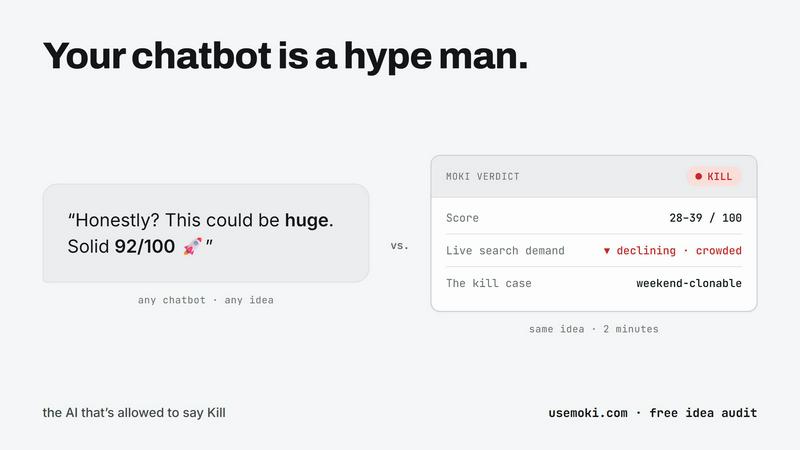
About moki - startup idea validation. you need
moki is an AI-powered startup idea validation tool designed to deliver a decisive, data-driven verdict on your business concepts before you commit significant time, resources, and capital. Unlike traditional validation methods that offer vague encouragement or generic feedback, moki provides a structured, honest assessment using a fixed academic methodology. It answers the critical question every founder faces: "Is this idea worth pursuing, or should I kill it now?" The tool evaluates your idea through a knockout gate, six weighted factors, and an adversarial kill case, all while integrating live Google search demand data that reflects current market behavior, not outdated training data. moki is built for entrepreneurs, product managers, and innovation teams who have more ideas than time and need a faster, more reliable way to say "no" to concepts that will not succeed. The core value proposition is efficiency: moki delivers a reasoned verdict in about two minutes, with no sign-up required for the first evaluation. It surfaces the fatal flaw, the factor dragging the score down, what would flip the verdict, and the cheapest experiment to settle the uncertainty. By providing a confidence range rather than a single fake number, moki enables you to make informed, ROI-driven decisions that prevent wasted months on ideas destined to fail. It is a strategic tool for reducing risk, accelerating the build/kill decision, and focusing resources on concepts with genuine market potential.
Features of moki - startup idea validation. you need
Honest Make/Hold/Kill Verdict with Confidence Range
moki eliminates the ambiguity of traditional scoring by providing a verdict of Make, Hold, or Kill based on a confidence range, not a single number. The system uses two hard decision lines: a worst-case score of 65 or above means Make, and a best-case score of 40 or below means Kill. For ideas that fall in between, moki provides a Hold verdict with specific guidance. If the band is wide, it advises gathering cheap evidence to reduce uncertainty. If the band is tight and mediocre, it recommends reshaping the idea or killing it. This feature ensures you never waste time arguing with a fake score and instead focus on the actionable decision.
Live Google Search Demand Analysis
moki pulls real-time Google search volume data to assess genuine market demand, not the applause of friends or the memory of a chatbot. It evaluates buying-intent queries, 12-month trends, competition levels, and market maturity. This feature provides a demand read that is either "Thin," "Moderate," or "Strong," giving you a clear picture of whether people are actually searching for solutions to the problem you aim to solve. By relying on current search behavior, moki ensures your validation is based on what the market is doing right now, not historical assumptions.
Six Weighted Factor Scoring with Weakest Link Identification
moki scores your idea across six critical factors: differentiation, market attractiveness, financial reward, risk (inverse), and others, each presented as a confidence range. The tool automatically surfaces the factors that are dragging down the overall score, allowing you to focus on the binding constraint rather than trying to fix everything at once. This feature provides a structured breakdown of where your idea breaks down, enabling targeted improvements. For example, if market attractiveness scores low, you know the issue is not with your execution but with the market itself.
Cheapest Experiment and Flip Condition
moki goes beyond diagnosis by prescribing a single, cheapest experiment that will shrink the biggest unknown and a specific change that would flip the verdict to Make. The tool also assesses whether that flip condition is reachable or out of reach. This feature saves you from the vague advice to "go talk to customers" and instead gives you a concrete, low-cost action plan. For instance, moki might recommend a pre-sell campaign before building anything, and if the required differentiation is out of reach, it provides a clear kill signal, saving you months of wasted effort.
Use Cases of moki - startup idea validation. you need
Validating a New SaaS Concept Before Building an MVP
A solo founder with a concept for an AI-powered project management tool can use moki to validate the idea before spending three months building a minimum viable product. By inputting the idea, the founder receives a verdict that includes live search demand data, a score range, and the weakest factor. If the verdict is Kill due to low market attractiveness or a crowded competitive landscape, the founder saves significant development time and resources. If it is a Hold, the founder receives guidance on the cheapest experiment to run, such as a landing page test, to gather evidence before committing to a full build.
Prioritizing Ideas in a Corporate Innovation Pipeline
A product manager at a mid-sized enterprise managing a backlog of 20 new feature ideas can use moki to triage and prioritize the most promising concepts. Instead of relying on internal bias or stakeholder pressure, the team can run each idea through moki to get an objective, data-driven score. Ideas that score in the Kill range are deprioritized immediately, freeing up engineering and design resources. Ideas in the Make range are fast-tracked, while those in the Hold category are assigned a low-cost experiment. This use case improves ROI by ensuring the team works only on ideas with validated market potential.
Evaluating a Side Project Before Leaving a Full-Time Job
An aspiring entrepreneur with a stable job and a side project idea can use moki to assess whether the concept is worth the risk of leaving their day job. The tool provides a verdict that includes the fatal flaw and the financial reward potential. If the verdict is Kill, the entrepreneur can avoid a potentially career-ending mistake. If it is Make, they gain the confidence to proceed, knowing the idea has cleared a rigorous validation gate. The tool's focus on the cheapest experiment also helps the entrepreneur test the idea on weekends without quitting their job prematurely.
Assessing a Pivot Direction for an Existing Startup
A startup team that has been working on a product for six months with little traction can use moki to evaluate a potential pivot. By inputting the new direction, the team receives a quick verdict on whether the pivot has a higher chance of success than the current path. The tool identifies the weakest link in the new idea, such as differentiation or market demand, and provides a flip condition. This use case prevents the team from making an emotional pivot and instead bases the decision on data, potentially saving the company from another six months of wasted effort.
Frequently Asked Questions
How does moki determine if an idea should be killed or pursued?
moki uses a fixed academic method with a knockout gate and six weighted factors. It scores your idea as a confidence range, not a single number. The decision rule is simple: if the worst-case score is 65 or higher, it is a Make. If the best-case score is 40 or lower, it is a Kill. For scores in between, moki provides a Hold verdict with specific guidance on whether to gather cheap evidence or reshape the idea. This structured approach ensures every verdict is reasoned and backed by data.
What kind of data does moki use to assess market demand?
moki pulls live Google search demand data that reflects what people are actually searching for this week. It evaluates buying-intent queries, 12-month search volume trends, competition levels, and market maturity. This data is current and dynamic, unlike static training data used by chatbots. The result is a demand read that tells you if the market is thin, moderate, or strong, and whether the trend is declining or growing. This ensures your validation is based on real-time market signals.
Do I need to create an account or sign up to use moki?
No, you do not need to sign up or create an account to use moki for your first idea evaluation. The process takes about two minutes and requires no 40-question onboarding. Simply input your idea and receive a verdict, including the score range, weakest factors, and next steps. This low-friction access allows you to validate ideas immediately without any commitment. If you want to evaluate additional ideas, you may need to sign up for a plan.
What is the "cheapest experiment" that moki recommends?
The cheapest experiment is a single, low-cost action designed to shrink the biggest unknown about your idea. moki recommends this experiment based on the specific weaknesses identified in your score. For example, if the biggest unknown is market demand, moki might recommend a pre-sell campaign before building anything. If the issue is differentiation, it might suggest a prototype test. The goal is to prove the idea wrong as cheaply as possible, saving you time and money before committing to a full development cycle.
Explore more in this category:
Similar to moki - startup idea validation. you need

IZIPAY is a virtual and physical crypto card service that lets users top up with digital assets and pay online like with a regular card.

Efficienco is a free collection of practical online calculators for construction, materials, home improvement, engineering, trades, and business.

Venduris is a renewal intelligence platform that gives mid-size companies control over SaaS & AI contract renewals before leverage disappears.


Owl Invoices lets you create professional invoices, download PDFs, manage billing, and use practical calculators for business, tax, finance, and pay.

Free Italian VAT calculator and tax guides, built for freelancers and businesses.
