
Self-Healing Integrations
Plumbed.io delivers self-healing enterprise integrations in days with AI-managed lifecycle automation to reduce costs and eliminate operational.
Visit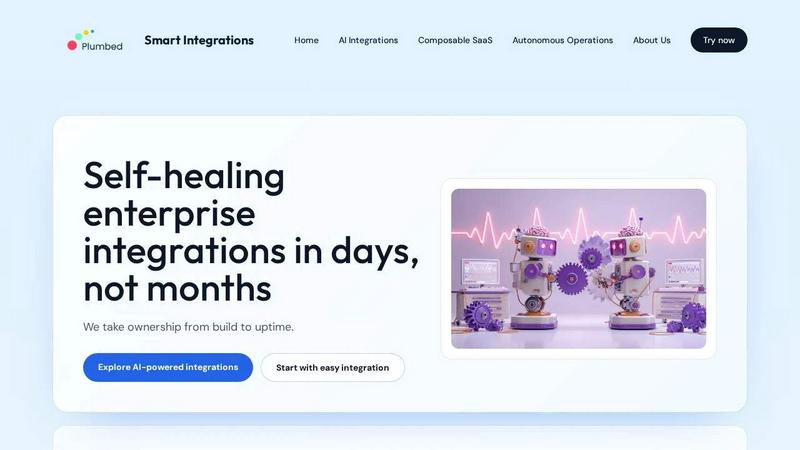
About Self-Healing Integrations
Self-Healing Integrations is an AI-managed integration lifecycle platform from Plumbed.io that fundamentally changes how enterprises build, deploy, and maintain system connections. Unlike traditional integration tools that focus solely on building connections, Plumbed.io takes full ownership of integrations from initial build through ongoing operations, ensuring they remain reliable, up-to-date, and self-sustaining. This product is designed for organizations burdened by the "integration tax" that makes launching new channels, systems, or partners slow and expensive. It replaces custom integration projects with a prompt-driven, production-ready, and self-healing approach that automates the entire integration lifecycle. Key capabilities include proactive error handling, continuous system updates, and automated monitoring that eliminates the need for constant manual intervention. The platform serves enterprise teams that require custom integrations requiring ongoing changes and maintenance after go-live, enabling them to scale efficiently without ballooning operational overhead. By leveraging AI to automate integration maintenance, Plumbed.io reduces delivery time, lowers maintenance effort, and makes complex system connections more reliable. The result is faster launches, lower costs, and zero overhead for engineering teams, allowing businesses to focus on growth rather than integration management.
Features of Self-Healing Integrations
AI-Powered Self-Healing Capabilities
The platform uses artificial intelligence to automatically detect, diagnose, and resolve integration issues before they impact operations. When a connection fails or data flow is interrupted, the AI immediately analyzes the root cause, applies corrective actions, and restores normal functionality without human intervention. This proactive error handling reduces downtime by up to 90% and eliminates the need for constant manual monitoring, allowing engineering teams to focus on strategic initiatives rather than firefighting integration problems.
Prompt-Driven Integration Building
Plumbed.io introduces a revolutionary prompt-driven approach to building integrations. Instead of writing complex code or configuring endless parameters, users describe their integration requirements in natural language prompts. The AI interprets these prompts and automatically generates the necessary connections, mappings, and transformations. This reduces integration build time from months to days, enabling enterprises to launch new channels, partners, or systems at unprecedented speed without sacrificing quality or reliability.
Automated Lifecycle Management
The platform automates the entire integration lifecycle from build to retirement. This includes continuous monitoring of all active connections, automatic updates when source or target systems change their APIs or data structures, and proactive maintenance to prevent degradation over time. The AI manages version control, handles backward compatibility issues, and ensures that all integrations remain operational even as underlying systems evolve. This eliminates the operational overhead typically associated with maintaining a growing portfolio of custom integrations.
Production-Ready Reliability
Every integration built on Plumbed.io is designed for production environments from day one. The platform includes built-in failover mechanisms, data validation rules, error handling protocols, and performance optimization that ensure integrations meet enterprise-grade reliability standards. The AI continuously tests and validates connections, monitors data integrity, and adjusts performance parameters to maintain optimal throughput. This production-first approach means organizations can deploy new integrations with confidence, knowing they will remain stable and reliable under real-world conditions.
Use Cases of Self-Healing Integrations
Enterprise CRM and ERP Synchronization
Large organizations often struggle to maintain real-time synchronization between their CRM and ERP systems, especially when custom fields, complex business rules, or frequent updates are involved. Plumbed.io automates this synchronization with self-healing capabilities that detect and resolve data mismatches, field mapping errors, or API changes automatically. The platform ensures that sales, finance, and operations teams always have access to accurate, up-to-date information without requiring dedicated integration engineers to manage the connection.
Multi-Channel E-Commerce Integration
Retailers and brands connecting to multiple e-commerce platforms, marketplaces, and fulfillment systems face constant challenges with changing APIs, inventory synchronization, and order management. Plumbed.io enables rapid deployment of new channel connections while the self-healing AI monitors all active channels for errors, data inconsistencies, or platform updates. When a marketplace changes its API specifications, the platform automatically adjusts the integration to maintain uninterrupted order processing and inventory accuracy across all channels.
Healthcare Data Exchange
Healthcare organizations need to connect electronic health records, billing systems, lab information systems, and third-party data sources while maintaining strict compliance with regulations. Plumbed.io automates these complex integrations with built-in data validation, error handling, and audit logging. The self-healing capabilities ensure that patient data flows accurately between systems, automatically resolving format mismatches, missing fields, or connectivity issues that could otherwise delay care or create compliance risks.
Financial Services System Integration
Banks, insurance companies, and fintech firms require highly reliable integrations between core banking systems, payment gateways, fraud detection platforms, and regulatory reporting tools. Plumbed.io provides the reliability and uptime these critical connections demand, with AI that proactively monitors transaction flows, detects anomalies, and resolves integration errors before they impact customers or compliance. The platform reduces the cost and complexity of maintaining dozens of financial system integrations while ensuring continuous operation.
Frequently Asked Questions
How does the self-healing capability actually work?
The self-healing feature uses AI models trained on thousands of integration scenarios to detect anomalies in data flow, API responses, and system connectivity. When an issue is detected, the AI immediately analyzes the root cause by examining error logs, response patterns, and historical data. It then applies the appropriate corrective action, which could include retrying failed requests, adjusting data mappings, updating API endpoints, or re-establishing connections. The entire process happens in seconds without human intervention, and the AI learns from each incident to improve future responses.
What types of integrations can Plumbed.io handle?
Plumbed.io is designed to handle any custom enterprise integration, including REST and SOAP APIs, database connections, file-based transfers, message queues, and legacy system interfaces. The platform supports both real-time and batch processing patterns and can connect to any system that exposes an API or data interface. It is particularly well-suited for complex integrations involving multiple systems, custom business logic, or frequent changes to connected applications.
How long does it take to deploy a new integration?
With the prompt-driven approach, most integrations can be built and deployed in days rather than the weeks or months required by traditional methods. Users describe their integration requirements in natural language, and the AI generates the connection automatically. Complex integrations with custom logic or multiple data transformations may require additional tuning, but the platform significantly reduces deployment time compared to custom coding or traditional integration platforms.
What happens when a connected system updates its API or data structure?
The AI continuously monitors all connected systems for changes to APIs, data schemas, or authentication methods. When a change is detected, the platform automatically analyzes the impact on existing integrations and applies necessary updates to maintain functionality. This includes remapping fields, updating endpoints, adjusting authentication tokens, and modifying data transformation rules. The self-healing capabilities ensure that integrations remain operational without requiring manual intervention or downtime.
Explore more in this category:
Similar to Self-Healing Integrations


Free Chrome extension. Paste your rough point and Chrome's built-in AI writes a fresh reply for that post on X, LinkedIn, Facebook or Instagram.

Verla is an AI academic assistant for university and college students, combining AI essay writing, academic research, AI detection.

Apps and files on an infinite canvas where people and AI agents work together.

Signage and kiosk infrastructure for AI agents. Your agent publishes images, video, streams, web pages and apps to screens via one plugin.screenRIG is

A tray helper for every AI coding tool: one searchable library of past sessions, waiting alerts and usage across 9 providers.

Soul Cinema is a cinematic AI image generator that turns a written shot into a film-grade still, with Soul ID character consistency across a sequence,
