
LLM Reference
LLM Reference helps tech leaders quickly find and compare the best AI models and providers for their specific project needs.
Visit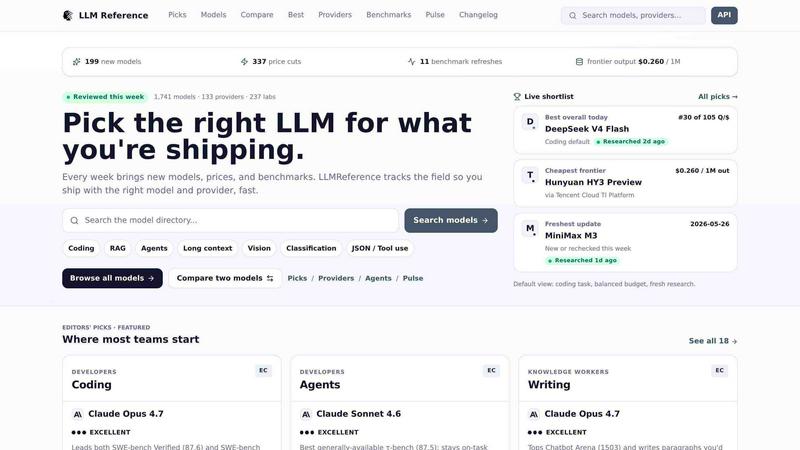
About LLM Reference
LLM Reference is a decision-support directory engineered for software engineers, technical architects, and technology leaders who need to select the optimal large language model (LLM) and provider in the rapidly evolving AI ecosystem. The platform tracks over 1,800 language models from more than 140 providers and 247 research labs, with data refreshed weekly to incorporate new releases, verified price changes, and updated benchmark scores. The core value proposition is eliminating the inefficiency of hunting through scattered sources, enabling teams to ship with confidence. Whether building a coding assistant, an agentic workflow, a writing tool, or a research pipeline, LLM Reference provides a single, authoritative repository for side-by-side model comparison, identification of the cheapest frontier output pricing, and curated editors picks for specific tasks including coding, agents, writing, research, image generation, and video creation. The platform is designed for fast triage, allowing users to quickly identify the right model for their job, determine the most cost-effective provider, and return to building. A Pulse feed highlights weekly changes, including new models, price cuts, and benchmark refreshes, keeping users informed without noise. Built by the Data Advantage project and updated daily, LLM Reference is an essential resource for anyone needing to stay current with the exploding LLM landscape.
Features of LLM Reference
Comprehensive Model Directory
The platform maintains an exhaustive directory of over 1,800 language models from more than 140 providers and 247 labs, updated weekly with new releases, verified price changes, and benchmark refreshes. Users can search by model name, provider, or task type, and filter by capabilities such as coding, RAG, agents, long context, vision, classification, and JSON or tool use. This breadth ensures that engineers and leaders can find both frontier and specialized models for any application.
Curated Editors Picks
For each major task category, LLM Reference provides expert-curated editors picks that identify the best models based on rigorous evaluation. Categories include coding, agents, writing, research, image generation, and video creation. Each pick includes a quality rating, key benchmark scores, and a brief rationale. For example, Claude Fable 5 is the top coding pick with 80.3 percent SWE-bench Pro and 96 percent SWE-bench Verified, while Claude Opus 4.7 leads writing with a 1503 Chatbot Arena score.
Side-by-Side Model Comparison
The compare feature enables users to evaluate two models directly against each other, viewing differences in benchmark performance, pricing, and provider availability. This tool is critical for making informed trade-offs between capability and cost, especially when selecting between frontier models like Claude Fable 5 versus GPT-5.5 or Claude Opus 4.8 versus Claude Opus 4.7. The comparison includes links to provider pages for further investigation.
Pulse Feed for Market Changes
The Pulse feed aggregates weekly changes across the model market, including new model releases, verified price cuts from providers, and benchmark refreshes. The platform currently tracks 177 new models, 53 price cuts, and 368 benchmark refreshes in the latest week. This feature allows users to monitor the market without manual research, ensuring they always have access to the most current and cost-effective options.
Use Cases of LLM Reference
Selecting a Production Coding Model
Engineering teams building coding assistants or agentic workflows need a model that excels at code generation, debugging, and tool use. Using LLM Reference, a team can compare Claude Fable 5, which achieves 80.3 percent on SWE-bench Pro and 96 percent on SWE-bench Verified, against alternatives like Claude Opus 4.8 or GPT-5.5. The editors picks and side-by-side comparison enable a data-driven decision that balances performance, cost, and provider reliability.
Optimizing Cost for Frontier Output
Technology leaders managing AI budgets can use LLM Reference to identify the cheapest provider for frontier output. The platform tracks top-lab output pricing per million tokens, currently highlighting Hunyuan HY3 Preview via Tencent Cloud TI Platform at 0.260 dollars per million output tokens. By comparing pricing across providers for the same model, teams can reduce operational costs without sacrificing model quality.
Identifying the Best Model for Content Creation
Knowledge workers and creative teams need models that produce high-quality writing, research summaries, or image and video content. LLM Reference provides editors picks for writing, research, image generation, and video creation. For example, Claude Opus 4.7 is recommended for writing with a Chatbot Arena score of 1503, while Veo 3.1 is the top video model with 30-second clips, native audio, and up to 4K resolution through Vertex AI.
Benchmarking Model Performance for Specific Tasks
Researchers and product managers can use the platform to evaluate models against specific benchmarks relevant to their use case. The platform tracks over 1,200 scores across major benchmark suites, including coding, agents, tool use, open weights, long context, cheap, writing, research, summarization, docs Q&A, translation, data and SQL, image, video, voice, transcription, music, and image editing. This granularity supports precise model selection for niche applications.
Frequently Asked Questions
How often is the model directory updated?
The model directory is updated weekly with new releases, verified price changes, and benchmark refreshes. The Pulse feed highlights what changed each week, including new models, price cuts, and benchmark updates. The platform currently tracks 177 new models, 53 price cuts, and 368 benchmark refreshes in the latest week.
How are editors picks determined?
Editors picks are curated by the Data Advantage team based on comprehensive evaluation of benchmark scores, real-world performance, provider reliability, and cost. Each pick includes a quality rating, key benchmark scores, and a brief rationale. Picks are updated as new models and benchmarks become available, ensuring recommendations remain current.
Can I compare two models side by side?
Yes, the compare feature allows you to evaluate two models directly against each other. You can view differences in benchmark performance, pricing, and provider availability. This tool is designed to support informed trade-offs between capability and cost, with links to provider pages for further investigation.
Is LLM Reference free to use?
Yes, LLM Reference is a free resource for engineers and technology leaders. There are no subscription fees or paywalls. The platform is supported by the Data Advantage project and updated daily to ensure users have access to the most current information for model selection.
Pricing of LLM Reference
LLM Reference is a free resource. There are no subscription fees, tiers, or costs associated with accessing the platform. The service is supported by the Data Advantage project and provides unrestricted access to the model directory, editors picks, comparison tools, Pulse feed, and all other features. Users can search, compare, and browse without any financial commitment.
Similar to LLM Reference

Apps and files on an infinite canvas where people and AI agents work together.

Signage and kiosk infrastructure for AI agents. Your agent publishes images, video, streams, web pages and apps to screens via one plugin.screenRIG is

A tray helper for every AI coding tool: one searchable library of past sessions, waiting alerts and usage across 9 providers.

Soul Cinema is a cinematic AI image generator that turns a written shot into a film-grade still, with Soul ID character consistency across a sequence,


Built2WinWeb is a custom PHP development studio and AI-native infrastructure provider.

