
act101
act101 is an enterprise AI agent tool with 163 grammars that refactors and ports code across languages, reducing token usage by 85% while keeping.
Visit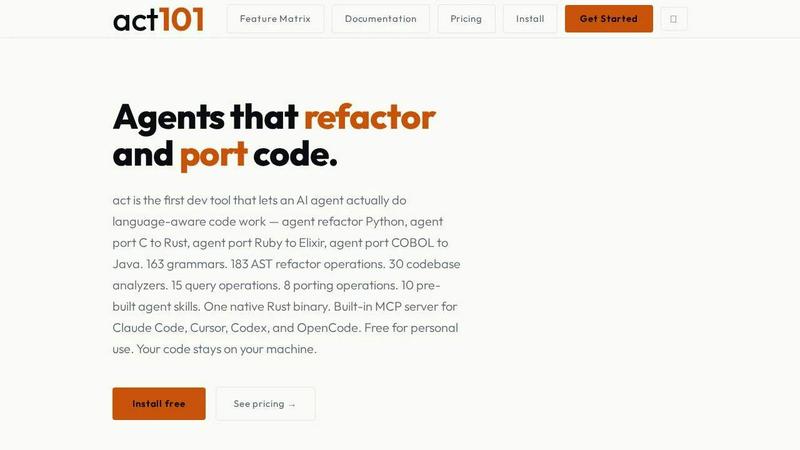
About act101
act101 is a groundbreaking developer tool that empowers AI coding agents to perform precise, language-aware code refactoring and cross-language porting across an unprecedented 163 programming languages. Unlike traditional AI coding assistants that rely on whole-file rewrites, act101 leverages a native Rust binary with a built-in Model Context Protocol (MCP) server to expose 183 Abstract Syntax Tree (AST) refactor operations, 30 codebase analyzers, 15 query operations, and 8 porting operations to leading AI agents including Claude Code, Cursor, Codex, and OpenCode. This tool fundamentally transforms how development teams approach code modernization, migration, and maintenance by enabling AI agents to execute typed, AST-aware operations such as extract-function, rename, move-symbol, and cross-language porting from C to Rust or COBOL to Java. With automatic checkpointing and instant undo on every operation, act101 eliminates the risks associated with AI-generated code changes while delivering approximately 85% fewer tokens than file-based operations. Designed for enterprise engineering teams, act101 operates entirely on the user's machine with no telemetry, no indexing, no caching, and no supply-chain attack surface, making it ideal for organizations prioritizing security and code sovereignty. The tool includes 10 pre-built agent skills that compose these operations into common engineering workflows, providing immediate productivity gains for architecture audits, code reviews, refactoring sessions, migration assessments, and boundary analysis.
Features of act101
163 Grammar Support in One Binary
act101 consolidates 163 programming language grammars into a single native Rust binary, eliminating the need for multiple parsers, plugins, or runtime environments. This comprehensive grammar support ensures that engineering teams working with diverse technology stacks can leverage AI agents for refactoring and porting across any language combination. The unified binary approach reduces operational complexity, deployment overhead, and maintenance burden while ensuring consistent parsing accuracy across all supported languages.
183 AST-Aware Refactor Operations
The tool exposes 183 typed, AST-aware refactor operations that enable AI agents to make surgical code changes with precision. Operations include extract-function, rename, move-symbol, inline, convert-to-dataclass, extract-trait, add-type-hints, generate-init, organize-imports, and 174 more. Each operation maintains cross-file consistency, preserves comments and formatting, and supports automatic checkpointing with instant undo. This granular control eliminates the destructive whole-file rewrites typical of standard AI coding assistants, reducing token consumption by approximately 85% and accelerating development cycles.
8 Cross-Language Porting Operations
act101 introduces a sophisticated state machine for end-to-end language migration through port_contract, port_inventory, port_order, and port_manifest operations. The port_contract anchors source-to-target migration, port_inventory enumerates every symbol requiring movement, port_order resolves dependency ordering, and the port_manifest state machine tracks progress through init, add, update, remove, and note stages. This structured approach enables reliable porting between any two of the 163 supported grammars, including complex migrations such as C to Rust, Ruby to Elixir, and COBOL to Java.
30 Codebase Analyzers for Structural Intelligence
The tool provides 30 sophisticated codebase analyzers that give AI agents a structural map of the repository before making any changes. Analyzers cover cohesion, coupling, cycles, chokepoints, hotspots, dead code detection, layers, seams, clusters, surface analysis, fan balance, migration readiness, and type completeness. These analyzers enable AI agents to understand architectural dependencies, identify refactoring opportunities, assess migration complexity, and make informed decisions about code transformations, significantly reducing the risk of unintended consequences during large-scale code modifications.
Use Cases of act101
Enterprise Application Modernization
Engineering teams can use act101 to systematically modernize legacy enterprise applications by porting aging codebases from languages like COBOL, Fortran, or C to modern alternatives such as Java, Rust, or Go. The tool's porting state machine ensures complete symbol inventory, dependency ordering, and progress tracking, enabling teams to migrate millions of lines of code with confidence. This capability directly reduces technical debt, improves maintainability, and extends the useful life of critical business systems while minimizing business disruption.
Cross-Platform Code Refactoring
Development teams working on multi-language codebases can leverage act101's 183 refactor operations to perform consistent refactoring across Python, TypeScript, Rust, Go, and other languages simultaneously. AI agents can extract functions, rename symbols, move modules, and reorganize imports across the entire codebase with cross-file consistency. This unified refactoring capability eliminates the need for language-specific tooling and enables teams to improve code quality, reduce duplication, and enforce architectural standards across heterogeneous technology stacks.
Migration Assessment and Planning
Before committing to a full language migration, engineering leaders can use act101's 30 codebase analyzers to assess migration readiness, identify coupling patterns, detect dead code, and evaluate architectural boundaries. The migration assessment agent skill composes these analyzers into a comprehensive report that quantifies migration complexity, identifies blocking dependencies, and provides actionable recommendations. This data-driven approach enables informed decision-making about migration scope, timeline, and resource allocation, reducing project risk and improving success rates.
Continuous Code Quality Enforcement
Engineering organizations can integrate act101 into their CI/CD pipelines to enable AI agents that perform automated code reviews, architecture audits, and health checks on every pull request. The 10 pre-built agent skills, including architecture-audit, code-review, and health-check, compose refactor operations and analyzers into repeatable workflows that enforce coding standards, detect architectural drift, and identify refactoring opportunities. This continuous quality enforcement reduces code review cycle times, improves codebase consistency, and prevents technical debt accumulation.
Frequently Asked Questions
How does act101 ensure code security and data privacy?
act101 operates entirely on the user's machine with no telemetry, no indexing, and no caching. The native Rust binary parses code on demand, so results are never stale and no code leaves the local environment. License verification may contact act101 servers, but no source code or metadata is transmitted. The single-binary design eliminates supply-chain attack surface, as there are no plugin runtimes, package graphs, or external dependencies that could introduce vulnerabilities.
What AI coding agents are compatible with act101?
act101 is MCP-native and works with any MCP-aware client, including Claude Code, Cursor, Windsurf, Codex, and OpenCode. The built-in MCP server exposes all 183 refactor operations, 30 analyzers, 15 query operations, 8 porting operations, and 10 pre-built agent skills through a standardized protocol. This compatibility ensures that engineering teams can use their preferred AI coding assistant without sacrificing access to act101's advanced capabilities.
Can act101 handle large enterprise codebases with millions of lines of code?
Yes, act101 is designed for enterprise-scale codebases. The Rust binary architecture provides high performance for parsing and analyzing large codebases, and the porting state machine enables systematic migration of millions of lines of code. The tool's analyzers can process entire repositories to identify coupling patterns, dead code, and migration readiness, while refactor operations maintain cross-file consistency across the entire codebase. Automatic checkpointing and instant undo provide safety mechanisms for large-scale transformations.
What is the token efficiency advantage of act101 compared to file-based operations?
act101 delivers approximately 85% fewer tokens than file-based operations because it operates at the AST level rather than rewriting entire files. Traditional AI coding assistants must send complete file contents for context, including unchanged code, comments, and formatting. act101's typed operations only transmit the specific transformation parameters, dramatically reducing token consumption. This efficiency translates to faster execution, lower API costs, and reduced latency for AI-assisted development workflows.
Pricing of act101
act101 is free for personal use. For commercial and enterprise licensing, teams should review the pricing page on the act101 website for current plan options, tiered pricing, and volume discounts. The free personal tier includes access to all 163 grammars, 183 refactor operations, 30 analyzers, 15 query operations, 8 porting operations, and 10 pre-built agent skills. Enterprise plans typically offer additional features such as priority support, custom integrations, and usage analytics.
Similar to act101

Moderation, routing, intent and scoring for any text over one Jev-compatible API, hosted in the EU.

Free directory of 950+ projects built on Laya, the open-source model that turns text into typed decisions in milliseconds.

A free browser-based toolkit for creating, cutting, converting, and previewing sprite sheet animations.

The #1 Native Form Builder Plugin for Framer - No Code, No Embeds, No External Platforms.

Where modern software products get discovered, launched, and distributed. Explore verified AI tools, SaaS startups, and developer software.


Free online screen and monitor tester with 28+ display tests for dead pixels, colors, brightness, contrast, gamma, and more.