
TDEE Calculator
Optimize your fitness ROI by calculating precise daily calorie targets using the validated Mifflin-St Jeor equation.
Visit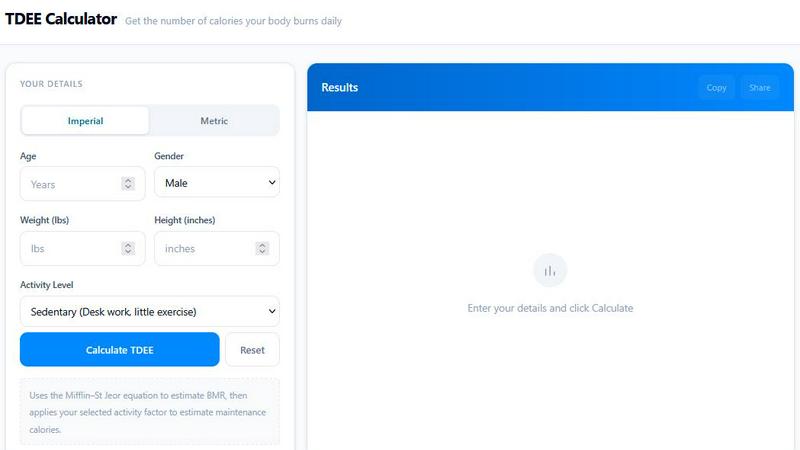
About TDEE Calculator
TDEE Calculator is a precision-engineered digital tool designed to provide enterprise-grade accuracy in estimating Total Daily Energy Expenditure (TDEE). Leveraging the scientifically validated Mifflin-St Jeor equation, this tool delivers reliable, data-driven caloric baselines that empower professionals and individuals to make informed decisions about energy balance, nutritional planning, and performance optimization. Unlike generic calculators, TDEE Calculator prioritizes speed, clarity, and actionable outputs, transforming complex physiological data into a straightforward metric that drives measurable outcomes. The tool is built for a diverse user base, including fitness professionals, nutrition coaches, corporate wellness programs, health tech platforms, and individuals committed to weight management, muscle development, or athletic performance. Its core value proposition lies in eliminating guesswork from caloric planning. By inputting age, sex, height, weight, and activity level, users receive an immediate, accurate estimate of their maintenance calories, along with practical deficit and surplus targets for fat loss or muscle gain. This enables users to set realistic, data-backed goals, track progress with confidence, and adjust strategies based on real-world results. The calculator also provides macro guidance and activity-based adjustments, making it a comprehensive tool for creating sustainable, personalized nutrition plans. Ultimately, TDEE Calculator enhances productivity by reducing the time spent on manual calculations and trial-and-error dieting, allowing users to focus on execution and results. It is a free, accessible resource that bridges the gap between scientific research and practical application, delivering a high return on investment in terms of time saved, goal clarity, and outcome predictability.
Features of TDEE Calculator
Scientifically Validated Calculation Engine
The core of TDEE Calculator is powered by the Mifflin-St Jeor equation, a formula extensively researched and validated in the American Journal of Clinical Nutrition for its superior accuracy in estimating Basal Metabolic Rate (BMR) in healthy adults. This engine accounts for sex-specific metabolic differences, calculating BMR for men as (10 x weight in kg) + (6.25 x height in cm) - (5 x age) + 5, and for women as (10 x weight in kg) + (6.25 x height in cm) - (5 x age) - 161. This provides a reliable physiological baseline, which is then multiplied by a user-selected activity factor to derive Total Daily Energy Expenditure (TDEE). This feature ensures that every caloric estimate is rooted in peer-reviewed science, not anecdotal guesswork, providing a trustworthy foundation for all subsequent planning.
Comprehensive Activity Level Integration
The tool offers a detailed, five-tier activity level selection system that precisely calibrates the TDEE output to an individual's lifestyle. Ranging from "Sedentary" (BMR x 1.2) for desk-bound professionals to "Athlete" (BMR x 1.9) for those with multiple daily training sessions, this feature eliminates the ambiguity of generic activity estimates. Each level is clearly defined, from "Light Exercise" (1.375) for casual activity 1-3 days a week to "Heavy Exercise" (1.725) for intense training 6-7 days a week. This granularity allows for a highly personalized estimate, directly impacting the accuracy of caloric targets for weight loss, muscle gain, or maintenance, thereby improving the ROI of any nutrition strategy.
Actionable Deficit and Surplus Recommendations
Beyond simply calculating maintenance calories, TDEE Calculator provides immediate, practical targets for goal-oriented users. For fat loss, it recommends a daily caloric deficit of 250-500 calories, a scientifically supported range that promotes sustainable weight loss without triggering severe metabolic adaptations. For muscle building, it suggests a daily surplus of 200-350 calories, which supports anabolic processes while minimizing excessive fat gain. These built-in recommendations transform raw data into a clear, actionable plan, saving users the time and cognitive load of researching and calculating these adjustments independently. This feature directly enhances productivity by providing a ready-to-implement strategy.
Intuitive User Interface and Instant Results
Designed for speed and clarity, TDEE Calculator features a streamlined interface that minimizes user friction. Users can quickly toggle between Imperial and Metric units, enter their details, and receive instant, shareable results with a single click. The "Copy" and "Share" functions facilitate easy integration of data into personal tracking apps, spreadsheets, or communications with coaches and healthcare providers. The tool also includes a "Reset" button for rapid re-calculation as user data changes, such as after weight loss. This focus on user experience reduces the time investment required to get a reliable caloric estimate, making it a highly efficient tool for busy professionals and individuals alike.
Use Cases of TDEE Calculator
Corporate Wellness Program Optimization
Human Resources and wellness program managers can deploy TDEE Calculator as a foundational tool for employee health initiatives. By providing employees with a precise understanding of their daily energy needs, companies can enhance the effectiveness of subsidized meal plans, fitness challenges, and health coaching programs. Employees can use their TDEE to set personalized nutrition goals, leading to better engagement and measurable improvements in workforce health metrics, such as reduced obesity rates and improved energy levels. This data-driven approach increases the ROI of corporate wellness investments by moving from generic advice to personalized, actionable plans that improve employee productivity and reduce healthcare costs.
Nutrition Coaching and Client Onboarding
For registered dietitians, nutritionists, and fitness coaches, TDEE Calculator serves as an efficient, science-backed onboarding tool. Instead of spending initial sessions on manual calculations, coaches can use the tool to quickly establish a client's baseline caloric needs, allowing more time for strategic planning, behavior coaching, and goal setting. The calculator's clear output provides a transparent starting point for discussions about caloric deficits or surpluses, building client trust and understanding from the first session. This streamlines the initial assessment process, improves client compliance by providing a clear roadmap, and allows coaches to scale their practice by reducing the time spent on administrative calculations.
Personal Performance and Body Composition Management
Athletes and serious fitness enthusiasts can use TDEE Calculator to precisely manage their energy balance for peak performance and physique goals. A competitive athlete can calculate their high TDEE to ensure they consume enough calories to fuel intense training and support recovery, preventing performance plateaus. Conversely, an individual preparing for a bodybuilding competition can use the deficit recommendations to achieve a specific body fat percentage while minimizing muscle loss. The ability to recalculate after changes in weight or activity level allows for continuous optimization of their nutrition plan, ensuring they are always operating from an accurate caloric baseline, which is critical for achieving specific, time-sensitive performance benchmarks.
Weight Management Program Integration
Healthcare providers and weight management clinics can integrate TDEE Calculator into their patient care protocols. For a patient aiming for sustainable weight loss, the calculator provides a clear, non-judgmental starting point by establishing their maintenance calories and a recommended deficit. This data helps clinicians and patients set realistic, achievable weekly weight loss targets (e.g., 0.5-1 kg per week based on a 500-calorie deficit). The tool also helps patients understand the relationship between activity level and caloric needs, reinforcing the importance of physical activity. This structured, data-driven approach improves patient adherence and outcomes, moving weight management from a subjective struggle to an objective, manageable process.
Frequently Asked Questions
What is the difference between TDEE and BMR?
Basal Metabolic Rate (BMR) is the number of calories your body needs to perform basic life-sustaining functions, like breathing and circulating blood, while at complete rest. Total Daily Energy Expenditure (TDEE) is a more comprehensive figure that includes your BMR, plus the energy used to digest food (thermic effect of food), and all calories burned through physical activity, from walking to your desk to intense exercise. TDEE Calculator first estimates your BMR using the Mifflin-St Jeor equation, then multiplies it by your activity factor to give you your TDEE, which is the true number of calories you burn in a typical day.
How accurate is the TDEE Calculator?
The TDEE Calculator is highly accurate for estimating the caloric needs of healthy adults, as it relies on the Mifflin-St Jeor equation, which is considered one of the most reliable formulas for predicting resting metabolic rate. However, it is important to treat the result as a starting estimate, not an absolute, perfect number. Individual metabolism can vary due to factors like genetics, muscle mass, and hormonal differences. For best results, use your calculated TDEE consistently for 2-3 weeks while monitoring your weight. If your weight remains stable, the estimate is likely very close; if you are losing or gaining weight, adjust your intake by 100-200 calories and reassess.
How many calories should I eat to lose weight?
To lose weight, you need to consume fewer calories than your Total Daily Energy Expenditure (TDEE), creating a caloric deficit. The TDEE Calculator recommends a daily deficit of 250 to 500 calories for most people. A 250-calorie deficit typically leads to a loss of about 0.5 lbs (0.25 kg) per week, while a 500-calorie deficit leads to a loss of about 1 lb (0.5 kg) per week. This range is considered safe and sustainable, promoting fat loss while minimizing muscle loss and metabolic slowdown. It is crucial not to create an excessively large deficit, as this can negatively impact energy levels, recovery, and hormonal health.
Should I recalculate my TDEE after losing weight?
Yes, you should definitely recalculate your TDEE after significant weight loss, typically a change of 10-15 lbs (5-7 kg) or more. As you lose weight, your body requires fewer calories to function, so your BMR and consequently your TDEE will decrease. If you continue eating the same number of calories that led to initial weight loss, your deficit will shrink, and your progress may slow or plateau. Recalculating with your new weight ensures your caloric targets remain accurate and effective, allowing you to continue progressing toward your goal. It is a simple, essential step for long-term success in any weight management plan.
Similar to TDEE Calculator

Generate random cycling routes at your target distance – from your front door, with wind optimization, elevation profiles and GPX export.

Pawjojo delivers enterprise-grade pet health tracking with five-second logs, automated trend analysis, and vet-ready reports to improve care outcomes.

PrettyScale delivers nine free, private AI beauty analysis tools that run entirely in your browser with zero uploads and no account required.

Holly AI automates patient scheduling and front desk tasks to increase revenue by 30% while reducing staff burnout.

Stop Smoking App boosts quit success by tracking smoke-free days, cravings, triggers, and money saved for both cigarettes and vaping.

Droidal Insurance Verification AI Agent ensures real-time eligibility checks to eliminate coverage surprises and reduce claim denials significantly.

Clearity is a CBT journaling tool that transforms anxious thoughts into actionable insights for improved mental clarity and productivity.
