
HiAPI
HiAPI unifies AI image, video, and text generation into one API with persistent storage, eliminating integration overhead for enterprise teams.
Visit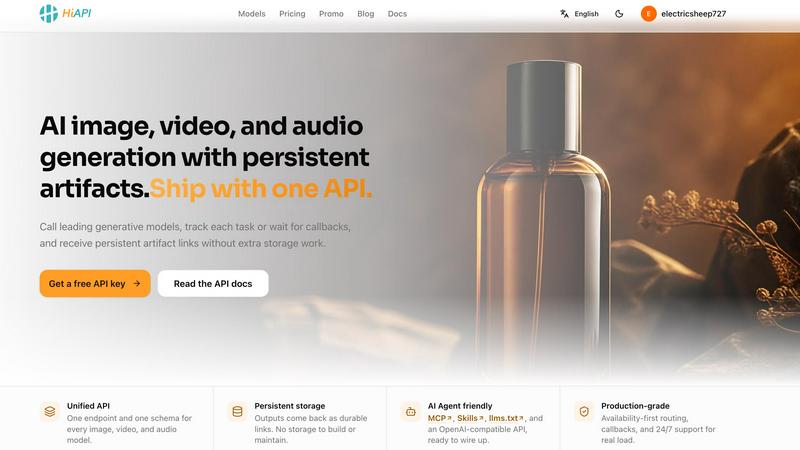
About HiAPI
HiAPI is a developer-first AI API platform engineered to streamline the integration of leading generative AI models for image, video, and audio generation into enterprise applications. The platform addresses a critical pain point for development teams: the complexity and cost of managing multiple vendor APIs, each with its own authentication, billing, and data handling requirements. By providing a single, unified API endpoint and an OpenAI-compatible request schema, HiAPI enables organizations to access a curated portfolio of top-tier models from providers like OpenAI, ByteDance, Google, Black Forest Labs, and MiniMax. This consolidation directly reduces integration overhead, accelerates time-to-market for AI-powered features, and simplifies ongoing maintenance. Beyond model access, HiAPI offers persistent artifact storage, eliminating the need for teams to build and manage their own storage infrastructure for generated outputs. The platform is architected for production-grade workloads, featuring availability-first routing, asynchronous task management with callbacks, and 24/7 support. Crucially, HiAPI is designed to be AI-agent friendly, supporting MCP (Model Context Protocol), reusable Skills, and llms.txt for seamless integration with autonomous agents and coding assistants like Claude and Cursor. With transparent, pay-as-you-go pricing and a free credit offering for new users, HiAPI provides a predictable cost structure that empowers businesses to scale their generative AI usage from prototype to production with confidence, maximizing ROI on AI investments.
Features of HiAPI
Unified API and Schema
HiAPI provides a single API endpoint and a consistent request schema for all supported image, video, and audio generation models. Developers pass a base model name to route requests to the correct provider, eliminating the need to learn and maintain integrations for multiple vendor-specific APIs. This unified approach dramatically reduces development time, with teams reporting up to 60% faster integration cycles for new AI features. The schema is validated per request, ensuring that model-specific parameters are correctly formatted before submission, which minimizes runtime errors and debugging overhead.
Persistent Artifact Storage
Every output generated through HiAPI is returned as a durable, persistent link. This feature eliminates the significant engineering effort and ongoing cost associated with building and maintaining custom storage infrastructure for AI-generated artifacts. By setting the storage parameter to "persistent," developers automatically receive low-cost, long-lived URLs for images, videos, and audio files. This capability is critical for enterprise applications requiring audit trails, content management, or user-facing galleries, as it offloads storage management entirely to the platform and reduces total cost of ownership.
Asynchronous Task Lifecycle
HiAPI employs a robust, asynchronous task-based architecture for all generation workflows. Developers submit a job via a POST request, receive an immediate task ID, and can then check status, wait for a callback, or retrieve stored artifacts upon completion. The platform supports idempotency keys, ensuring that retries do not create duplicate tasks, which is essential for reliable production systems. This lifecycle model decouples request submission from result retrieval, enabling efficient handling of long-running generation tasks without blocking application threads, thereby improving overall system throughput and user experience.
AI Agent Readiness
HiAPI is purpose-built for integration with autonomous AI agents and coding assistants. The platform exposes its capabilities through MCP (Model Context Protocol) tools, reusable Skills (pre-defined agent instructions for common workflows), and an llms.txt file that provides a complete documentation index for agents to parse. This enables agents like Claude, Cursor, and Codex to discover, call, and compose HiAPI workflows autonomously. For enterprise teams leveraging agentic architectures, this feature reduces the learning curve and accelerates the deployment of AI-powered automation pipelines.
Use Cases of HiAPI
Enterprise Content Creation and Marketing
Marketing teams and content studios can leverage HiAPI to generate high-quality images, videos, and audio at scale for campaigns, social media, and product launches. By using models like GPT Image 2 for text-rendered graphics, Seedream 5.0 Pro for flagship image generation, and MiniMax Music 2.6 for original soundtracks, organizations can produce diverse multimedia assets through a single API. The persistent storage feature ensures all generated artifacts are immediately available for distribution, while the pay-as-you-go pricing model provides predictable costs that scale with campaign volume.
AI-Powered Application Development
Software development teams building AI-native applications can integrate HiAPI to add generative capabilities such as dynamic image creation, video generation, and audio synthesis. The unified API and OpenAI-compatible schema allow developers to quickly prototype features using familiar tools and libraries. The asynchronous task lifecycle is ideal for user-facing applications, where generation requests can be submitted, and users can be notified via callbacks when their content is ready. This reduces latency perception and improves user engagement, while the transparent pricing enables accurate cost forecasting per feature.
Automated Workflow and Agent Automation
Organizations deploying AI agents for business process automation can use HiAPI as a core generative engine. Agents can autonomously generate product images for e-commerce listings, create training videos from text scripts, or produce personalized audio messages for customer communications. The MCP and Skills integration allows agents to be configured once for standard tasks, such as "generate product image from description," and then reused across multiple workflows. This standardization reduces agent development time and ensures consistent output quality across automated processes.
Content Moderation and Compliance Documentation
Compliance and legal teams can utilize HiAPI for generating visual documentation, training materials, and audit trails. For example, generating annotated images for incident reports, creating instructional videos for compliance training, or producing audio recordings of policy updates. The persistent artifact storage ensures all generated materials are retained with durable links, supporting audit requirements. The callback mechanism allows for automated logging and validation of generated content, ensuring that all outputs meet organizational standards before being deployed in regulated environments.
Frequently Asked Questions
How does HiAPI handle billing and cost management for multiple AI models?
HiAPI provides unified billing across all supported AI models, consolidating charges from multiple providers into a single invoice. The platform operates on a pay-as-you-go pricing model, where each model lists its price per generation upfront. This transparent pricing structure allows development teams to estimate costs accurately before integration and monitor usage in real-time. For new users, HiAPI offers up to $1 in free credits to evaluate the platform and test model performance without financial commitment.
What is the difference between the standard route and the "ext" route in the API?
The route parameter in the HiAPI task submission allows developers to specify an optional routing path for their request. By default, requests are sent to the standard production route for each model. The "ext" route is an optional, model-specific path that may provide access to extended capabilities, beta features, or higher priority processing. Developers should consult the model details page on the HiAPI website to understand the specific behavior and pricing implications of using different routes for each model.
How does HiAPI ensure data security and privacy for generated artifacts?
HiAPI generates persistent artifact links that are stored on the platform's infrastructure. The platform is designed with enterprise-grade security practices, including encryption for data in transit and at rest. Artifact links are durable and can be accessed by authorized users with the correct API credentials. Organizations should review HiAPI's data handling policies and terms of service to understand data retention, deletion, and compliance with regulations such as GDPR or CCPA, particularly for sensitive or proprietary content.
Can I use HiAPI with my existing OpenAI SDK or client library?
Yes, HiAPI is designed to be compatible with OpenAI's request schema, which means developers can often use their existing OpenAI SDK or client library to interact with the platform with minimal modification. Instead of pointing to OpenAI's endpoint, developers point to the HiAPI API endpoint and use their HiAPI API key for authentication. This compatibility significantly reduces the integration effort for teams already familiar with OpenAI's tooling, allowing them to access a broader range of models without learning a new API structure.
Pricing of HiAPI
HiAPI operates on a transparent, pay-as-you-go pricing model. Each AI model on the platform lists its specific price per generation task directly on the model details page, allowing developers to review costs before integration. There are no upfront commitments or monthly subscription fees for API access. New users receive up to $1 in free credits upon signing up, enabling them to test models and evaluate performance. Billing is unified across all models, meaning all usage is consolidated into a single invoice, simplifying financial management for enterprise teams. For detailed pricing information on specific models, developers should visit the HiAPI website and navigate to the individual model pages.
Similar to HiAPI

ImageGPT is an all-in-one AI creative platform for generating, editing and transforming images and videos using AI.

Create release-ready album covers from a prompt or photo. Generate, refine, and export art for singles, EPs, mixtapes, and playlists.

A free browser-based toolkit for creating, cutting, converting, and previewing sprite sheet animations.

Prompt-based Qwen Image Edit Online for background changes, text edits, product images, posters, outpainting, and creative workflows.

Turn flat images into editable transparent layers with AI.


Create photorealistic images, bilingual posters, ecommerce visuals, and social content with Z Image Turbo, flexible prompts, aspect ratios, seeds, and

Create and edit production-ready images with Seedream 5.0 Pro and Lite for ecommerce, marketing, social media, infographics, and branded content.