
Project20x vs Sketch To
Side-by-side comparison to help you choose the right AI tool.

Project20x
Project20x delivers AI governance that ensures compliance and drives measurable productivity gains.
Last updated: March 4, 2026
Sketch To
Sketch To leverages AI to instantly convert images into professional sketches, boosting creative productivity and ROI.
Last updated: February 28, 2026
Visual Comparison
Project20x
Sketch To
Feature Comparison
Project20x
Governance Layer: AI-Powered Policy Analysis
This foundational layer employs a sophisticated ten-step AI methodology to assist lawmakers in crafting robust, clear, and conflict-free legislation. The AI analyzes draft legislative texts, identifying ambiguities, potential legal conflicts, and gaps in logic before policies are enacted. This proactive analysis de-risks the legislative process, reduces future compliance issues, and ensures policies are built on a sound, executable foundation from the outset, leading to more effective governance.
Management Layer: Rules as Code Automation
Once a policy is approved, the Management Layer automatically translates its natural language rules into functional, machine-executable code. This "Rules as Code" paradigm creates efficient, automated workflows for backend governmental operations. It eliminates manual interpretation errors, accelerates the deployment of new regulations, and enables real-time updates to systems, ensuring that public service management is as dynamic and precise as the policies it serves.
Interface Layer: 24/7 Citizen AI Agents
The Interface Layer provides citizens with direct, always-available access to AI agents trained on the codified policies. These agents can answer complex regulatory questions, guide users through application processes, and facilitate public service interactions without wait times. This feature dramatically improves citizen satisfaction and agency productivity by deflecting routine inquiries, allowing human staff to focus on high-value, exceptional cases.
End-to-End Transparency & Audit Framework
Project20x is built with an immutable audit trail, ensuring every automated decision, policy interaction, and workflow execution is fully traceable and quantifiable. This framework provides unparalleled transparency for oversight bodies and citizens alike, while maintaining rigorous human-in-the-loop controls for critical decisions. It turns governance into a data-driven function, enabling performance measurement and continuous improvement based on concrete metrics.
Sketch To
Bidirectional AI Conversion Engine
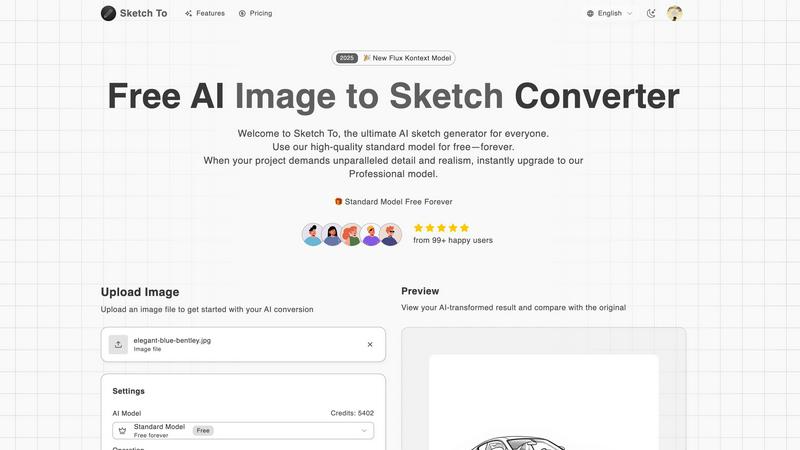
Sketch To's foundational technology is its dual-direction conversion capability. The platform can intelligently analyze a photograph and decompose it into a precise, artistic sketch across multiple styles like pencil, charcoal, ink, or watercolor. Conversely, its advanced Pro model can interpret hand-drawn sketches, adding texture, lighting, and material details to generate stunningly realistic images. This dual functionality provides a complete toolkit for iterative design and visual storytelling within a single platform.
Tiered AI Model Architecture for Scalable Workloads
The platform operates on a sophisticated two-tier model system to align cost with project requirements. The Standard Model provides high-quality, efficient conversions perfect for internal brainstorming, social media content, and preliminary drafts. For professional outputs, the Pro Model unlocks superior algorithmic processing for world-class detail, accuracy, and realism, ensuring results are suitable for commercial advertising, product visualization, and high-stakes client presentations.
Enterprise-Grade Processing Infrastructure
Built for business continuity and team productivity, Sketch To delivers instant processing through a powerful, cloud-based AI engine. This eliminates local hardware limitations and software installation, allowing teams to convert images in seconds directly from any web browser. The infrastructure supports high-resolution uploads and outputs, ensuring final assets are ready for print, digital campaigns, and integration into other professional design software without quality degradation.
Centralized Asset Management and Preview Tools
The platform streamlines the review and approval process with integrated professional tools. Users can manage conversions and access their asset history. A dedicated preview panel features a drag-to-compare slider, enabling precise before-and-after analysis critical for quality assurance and client reviews. This centralized workflow minimizes context switching and accelerates decision-making cycles for creative projects.
Use Cases
Project20x
Streamlining Federal Grant Applications
Agencies like USAID or the Department of Education can use Project20x to codify complex grant eligibility rules and application procedures. The platform's AI agents provide instant, accurate guidance to applicants, while automated workflows pre-screen submissions for compliance. This reduces processing times from months to days, minimizes administrative errors, and ensures funds are distributed more efficiently and fairly.
Modernizing Regulatory Compliance for Businesses
The Department of Commerce can deploy Project20x to transform dense regulatory frameworks (e.g., export controls, trade regulations) into interactive digital services. Businesses can query an AI agent to understand specific compliance requirements for their scenario. This use case reduces the regulatory burden on industry, fosters economic growth, and allows agency compliance officers to leverage automated monitoring.
Accelerating Veteran Benefit Claims Processing
The Department of Veterans Affairs can implement the platform to automate the evaluation of benefit claims against codified eligibility statutes. The system can instantly verify service records, cross-reference medical criteria, and flag claims for human review only when necessary. This accelerates support to veterans, improves claim accuracy, and optimizes caseworker productivity.
Legislative Drafting and Impact Simulation
Lawmakers can utilize the Governance Layer as a collaborative drafting tool. As legislation is written, the AI simulates its impact by analyzing conflicts with existing laws and forecasting implementation challenges. This allows for data-informed policymaking, reduces unintended consequences, and creates legislation that is inherently easier and less costly for agencies to execute upon passage.
Sketch To
Marketing and Advertising Asset Production
Marketing teams can rapidly generate unique artistic visuals for campaigns, social media posts, and website content. Convert product photography into elegant sketch-style imagery for premium branding, or transform conceptual mood board sketches into realistic mock-ups to secure stakeholder buy-in before production, significantly shortening the creative development cycle.
Product Design and Architectural Visualization
Designers and architects can instantly convert CAD renders or product photos into hand-drawn style sketches for client presentations or portfolio pieces. More powerfully, they can sketch initial concepts by hand, upload them, and use the Pro model to generate photorealistic renderings of products, buildings, or interiors, facilitating faster iteration and more compelling visual proposals.
Entertainment and Storyboarding
Film, animation, and game development studios can use Sketch To to quickly convert location photos into storyboard-ready sketch art or transform rough storyboard panels into more detailed concept art. This accelerates pre-production, helps visualize scenes more effectively, and provides clear visual guidance for production teams, optimizing resource allocation.
Education and Training Material Development
Educational institutions and corporate training departments can enhance learning materials by converting complex diagrams, photographs, or technical illustrations into clear, simplified sketches. This improves comprehension and retention. Conversely, instructors can sketch out ideas and convert them into polished images for presentations, textbooks, and online course content, improving production value.
Overview
About Project20x
Project20x is an enterprise-grade, AI-native platform engineered to transform governmental efficiency and public engagement. It serves as a critical digital infrastructure for government agencies, lawmakers, and citizens, systematically bridging the gap between complex policy creation and its real-world implementation. The platform's core value proposition lies in its unique three-layer architecture, which translates legislative intent into automated, transparent, and measurable processes. By applying a rigorous ten-step AI methodology to policy development and pioneering "Rules as Code" for execution, Project20x directly addresses operational bottlenecks, reduces administrative overhead, and delivers quantifiable ROI through enhanced service delivery speed and accuracy. It ensures every governmental action is traceable, data-driven, and subject to human oversight, fundamentally modernizing governance for the 21st century with a focus on security, accountability, and citizen-centric design.
About Sketch To
Sketch To is an enterprise-grade AI image processing platform engineered to transform visual content creation workflows. It provides a sophisticated, cloud-based solution for bidirectional conversion between photographs and artistic sketches, leveraging advanced artificial intelligence models. The platform is designed for a broad spectrum of users, from marketing teams and product designers to architects and professional illustrators, addressing the critical need for rapid, high-fidelity visual prototyping and asset generation. Its core value proposition lies in delivering measurable ROI by drastically reducing the time and specialized skill required to produce studio-quality sketches from images, or to render conceptual sketches into photorealistic visuals. With a tiered model system, Sketch To offers a scalable solution: a robust Standard Model for cost-effective ideation and internal projects, and a premium Professional Model that delivers unparalleled detail and commercial-grade realism for client-facing work and final deliverables. The platform's instant processing, high-resolution output, and seamless integration into creative pipelines make it an indispensable tool for businesses seeking to enhance productivity, accelerate project timelines, and unlock new creative possibilities without capital investment in specialized talent or software.
Frequently Asked Questions
Project20x FAQ
How does Project20x ensure the security of sensitive government data?
Project20x is architected for the highest levels of government security requirements. It employs end-to-end encryption, strict access controls, and operates within government-certified cloud or on-premise environments. All data processing and AI training occur within a secure, sovereign boundary, with every access and action logged in the immutable audit framework to prevent and detect any unauthorized activity.
What is the implementation timeline and resource requirement for an agency?
Implementation is modular and scalable, typically beginning with a pilot on a specific regulatory process within 3-6 months. Project20x provides dedicated integration teams who work alongside agency subject matter experts to map and codify policies. The platform's AI-driven design reduces the heavy technical lift traditionally associated with IT modernization, allowing agencies to focus on policy logic rather than software development.
How does the platform handle changes or updates to existing policies?
The "Rules as Code" foundation makes policy updates highly efficient. When a law or regulation is amended, authorized personnel can update the central policy logic within the Management Layer. These changes are then propagated automatically across all connected workflows and AI agent knowledge bases, ensuring immediate and consistent application without needing to manually reprogram multiple disparate systems.
Can Project20x integrate with our agency's existing legacy systems?
Yes, a core design principle of Project20x is interoperability. The platform features robust APIs (Application Programming Interfaces) and integration adapters that allow it to connect securely with existing case management systems, databases, and citizen portals. This approach protects previous IT investments while layering on advanced automation and AI capabilities to modernize the entire service delivery chain.
Sketch To FAQ
What is the difference between the Standard and Professional AI models?
The Standard Model is optimized for speed and efficiency, delivering high-quality sketch conversions suitable for personal projects, internal drafts, and social media content. The Professional Model utilizes advanced, compute-intensive algorithms to produce outputs with exceptional detail, texture accuracy, and photorealistic quality. It is engineered for commercial use, professional artwork, and any project where the highest fidelity is a non-negotiable requirement, directly impacting perceived value and client satisfaction.
What file formats and resolutions does Sketch To support for input and output?
Sketch To accepts common image file formats for upload, including JPG and PNG. The platform is engineered to process high-resolution inputs, and outputs are generated in high resolution, making them suitable for both digital use and professional printing. For specific size limits and format details, users should refer to the upload interface within the tool, which is designed to guide optimal asset preparation.
How does the credit system work for image conversions?
Conversions on Sketch To consume credits. The Standard Model typically uses 1 credit per conversion, while the Professional Model, due to its advanced processing, uses 2 credits. New users receive complimentary trial credits to evaluate the Standard Model. Subsequent usage requires purchasing a subscription plan or credit pack, providing businesses with predictable budgeting and scalable access based on project volume and quality needs.
Is my data secure and private when using Sketch To?
Sketch To is built with a focus on professional use, which includes considerations for data handling. Uploaded images are processed securely via cloud infrastructure. For detailed information on data retention, privacy policies, and security protocols, users should consult the official Sketch To Terms of Service and Privacy Policy documents to ensure compliance with their organizational data governance standards.
Alternatives
Project20x Alternatives
Project20x is an enterprise-grade AI governance platform designed to translate complex regulatory policies into automated, compliant digital workflows. It belongs to the broader category of AI assistants and governance solutions that help organizations manage policy lifecycle and public engagement with precision and accountability. Organizations may seek alternatives to Project20x for various strategic reasons. Common drivers include budget constraints, specific feature requirements not covered by the core platform, or the need for integration with an existing legacy technology stack. Some may also prioritize different aspects of the implementation process or seek solutions with a narrower or broader functional scope. When evaluating an alternative AI governance solution, key considerations should include the platform's ability to ensure regulatory compliance, its methodology for translating policy into executable code, and the robustness of its security and audit protocols. Additionally, assess the total cost of ownership, scalability for future needs, and the level of human oversight and transparency provided throughout the automated process.
Sketch To Alternatives
Sketch To is a specialized AI assistant within the image processing category, designed to transform photographs into artistic sketches and vice versa using advanced artificial intelligence. It serves as a productivity tool for creatives seeking to streamline visual content creation. Users may evaluate alternatives to Sketch To for several strategic reasons. These include aligning tool capabilities with specific enterprise workflows, requiring different pricing or licensing models for team deployment, or needing integration with existing creative software ecosystems. Platform compatibility and the need for advanced, industry-specific features also drive the search for comparable solutions. When selecting an alternative AI image processing tool, key considerations should include the total cost of ownership, the quality and speed of output as it impacts project timelines, and the tool's ability to integrate into a professional pipeline. Security of data processing and the scalability of features to match growing creative demands are also critical factors for business adoption.