
Project20x vs Quitlo
Side-by-side comparison to help you choose the right AI tool.

Project20x
Project20x delivers AI governance that ensures compliance and drives measurable productivity gains.
Last updated: March 4, 2026

Quitlo uses AI voice calls to uncover the real reasons for churn, delivering actionable insights to your team.
Last updated: March 4, 2026
Visual Comparison
Project20x

Quitlo
Feature Comparison
Project20x
Governance Layer: AI-Powered Policy Analysis
This foundational layer employs a sophisticated ten-step AI methodology to assist lawmakers in crafting robust, clear, and conflict-free legislation. The AI analyzes draft legislative texts, identifying ambiguities, potential legal conflicts, and gaps in logic before policies are enacted. This proactive analysis de-risks the legislative process, reduces future compliance issues, and ensures policies are built on a sound, executable foundation from the outset, leading to more effective governance.
Management Layer: Rules as Code Automation
Once a policy is approved, the Management Layer automatically translates its natural language rules into functional, machine-executable code. This "Rules as Code" paradigm creates efficient, automated workflows for backend governmental operations. It eliminates manual interpretation errors, accelerates the deployment of new regulations, and enables real-time updates to systems, ensuring that public service management is as dynamic and precise as the policies it serves.
Interface Layer: 24/7 Citizen AI Agents
The Interface Layer provides citizens with direct, always-available access to AI agents trained on the codified policies. These agents can answer complex regulatory questions, guide users through application processes, and facilitate public service interactions without wait times. This feature dramatically improves citizen satisfaction and agency productivity by deflecting routine inquiries, allowing human staff to focus on high-value, exceptional cases.
End-to-End Transparency & Audit Framework
Project20x is built with an immutable audit trail, ensuring every automated decision, policy interaction, and workflow execution is fully traceable and quantifiable. This framework provides unparalleled transparency for oversight bodies and citizens alike, while maintaining rigorous human-in-the-loop controls for critical decisions. It turns governance into a data-driven function, enabling performance measurement and continuous improvement based on concrete metrics.
Quitlo
Adaptive AI Voice Conversations
Quitlo's core feature is its AI-driven voice and text conversations that replace static surveys. When a churn signal is detected, the AI initiates a natural, two-minute dialogue, asking intelligent, empathetic follow-up questions based on the customer's initial response. This adaptive conversation uncovers the full story—context, sentiment, and underlying motives—that a dropdown menu or one-word answer never could, turning superficial feedback into deep, qualitative intelligence.
Automated Signal Detection & Triggers
The platform seamlessly integrates with your stack to automatically monitor and detect key customer lifecycle signals without manual intervention. It triggers conversations based on specific events like a user initiating cancellation, submitting a low CSAT/NPS score, a payment failure, post-onboarding silence, or for win-back campaigns. This ensures no critical moment for insight or recovery is missed, enabling proactive customer retention.
Structured, Actionable Intelligence Delivery
Within minutes of a conversation concluding, Quitlo synthesizes the dialogue into a concise, structured summary delivered to tools like Slack, Microsoft Teams, or Jira. This summary highlights the definitive churn reason, quantifies customer sentiment, flags competitor mentions, assesses the save opportunity (High/Medium/Low), and provides a suggested next action, enabling teams to act immediately with context.
Unified Churn Intelligence Across Five Entry Points
Quitlo operates through five integrated modules—Cancel Flows, Surveys, Payment Recovery, Check-Ins, and Win-Back—all powered by the same AI conversation engine. This provides a consistent methodology and intelligence output whether the signal comes from a cancellation, a survey, or a failed payment, creating a single source of truth for all churn-related customer insights across the organization.
Use Cases
Project20x
Streamlining Federal Grant Applications
Agencies like USAID or the Department of Education can use Project20x to codify complex grant eligibility rules and application procedures. The platform's AI agents provide instant, accurate guidance to applicants, while automated workflows pre-screen submissions for compliance. This reduces processing times from months to days, minimizes administrative errors, and ensures funds are distributed more efficiently and fairly.
Modernizing Regulatory Compliance for Businesses
The Department of Commerce can deploy Project20x to transform dense regulatory frameworks (e.g., export controls, trade regulations) into interactive digital services. Businesses can query an AI agent to understand specific compliance requirements for their scenario. This use case reduces the regulatory burden on industry, fosters economic growth, and allows agency compliance officers to leverage automated monitoring.
Accelerating Veteran Benefit Claims Processing
The Department of Veterans Affairs can implement the platform to automate the evaluation of benefit claims against codified eligibility statutes. The system can instantly verify service records, cross-reference medical criteria, and flag claims for human review only when necessary. This accelerates support to veterans, improves claim accuracy, and optimizes caseworker productivity.
Legislative Drafting and Impact Simulation
Lawmakers can utilize the Governance Layer as a collaborative drafting tool. As legislation is written, the AI simulates its impact by analyzing conflicts with existing laws and forecasting implementation challenges. This allows for data-informed policymaking, reduces unintended consequences, and creates legislation that is inherently easier and less costly for agencies to execute upon passage.
Quitlo
Recovering At-Risk Customers During Cancellation
When a customer clicks "cancel," Quitlo's smart cancel widget engages them with an optional AI voice conversation instead of a simple form. This real-time dialogue can uncover that "pricing" actually means "I'd stay with a team-tier plan," revealing a direct save opportunity that would otherwise be lost, allowing the CS team to intervene with a tailored offer before the churn is finalized.
Investigating Root Causes of Low NPS/CSAT Scores
For customers who provide a low promoter or satisfaction score, Quitlo automatically initiates a follow-up conversation. This moves beyond a mere number to understand the "why" behind the dissatisfaction, such as a specific missing integration or a frustrating UI element, providing product and success teams with direct, actionable feedback for improvement.
Recovering Revenue from Failed Payments
Instead of sending generic payment failure emails, Quitlo triggers an AI conversation with the cardholder. This personal touch can quickly determine if the issue is a simple expired card, a billing dispute, or a decision to cancel, dramatically increasing recovery rates by resolving issues proactively and saving otherwise salvageable accounts.
Conducting Post-Churn Win-Back Campaigns
Quitlo can automate win-back outreach to customers who churned 90 days prior. The AI engages them in a conversation to understand if their situation has changed—such as a new budget or dissatisfaction with a competitor—identifying potential candidates for re-activation with a high degree of precision, turning lost revenue into recovered ARR.
Overview
About Project20x
Project20x is an enterprise-grade, AI-native platform engineered to transform governmental efficiency and public engagement. It serves as a critical digital infrastructure for government agencies, lawmakers, and citizens, systematically bridging the gap between complex policy creation and its real-world implementation. The platform's core value proposition lies in its unique three-layer architecture, which translates legislative intent into automated, transparent, and measurable processes. By applying a rigorous ten-step AI methodology to policy development and pioneering "Rules as Code" for execution, Project20x directly addresses operational bottlenecks, reduces administrative overhead, and delivers quantifiable ROI through enhanced service delivery speed and accuracy. It ensures every governmental action is traceable, data-driven, and subject to human oversight, fundamentally modernizing governance for the 21st century with a focus on security, accountability, and citizen-centric design.
About Quitlo
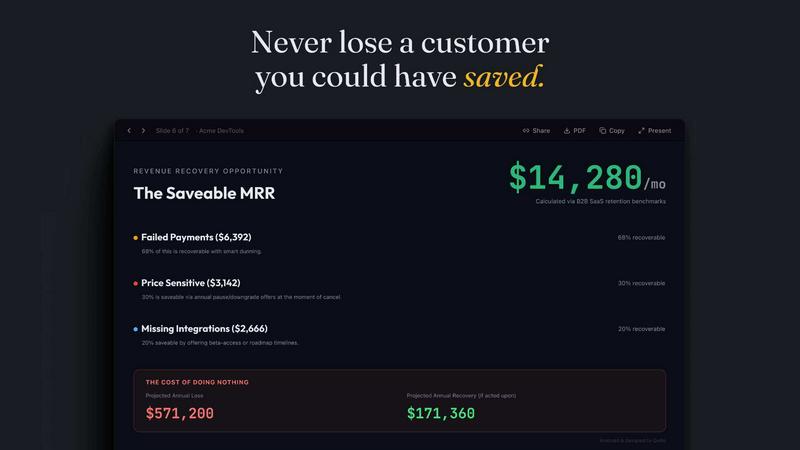
Quitlo is the first Churn Intelligence Platform engineered specifically for B2B SaaS companies. It directly addresses the critical revenue leak caused by inadequate customer feedback. Traditional methods like exit surveys and static cancel forms fail, delivering response rates below 8% and one-word, unactionable answers like "pricing." This leaves product, customer success, and growth teams guessing, unable to formulate effective retention strategies. Quitlo solves this by replacing passive forms with adaptive, empathetic AI conversations—conducted via both voice and text—that actively engage customers at pivotal moments across their lifecycle. The platform automatically detects churn signals such as a subscription cancellation, a low NPS score, or a failed payment, and initiates a genuine, two-minute dialogue. Its intelligent AI asks contextual follow-up questions to uncover the complete narrative behind the signal. Within minutes, a structured, actionable summary is delivered directly to operational hubs like Slack or Jira, detailing the precise churn reason, customer sentiment, competitor mentions, and clear save opportunities. For SaaS teams losing customers they don't understand, Quitlo transforms a single, vague data point into a concrete retention playbook, directly saving revenue and providing the strategic intelligence needed to improve product-market fit and customer experience.
Frequently Asked Questions
Project20x FAQ
How does Project20x ensure the security of sensitive government data?
Project20x is architected for the highest levels of government security requirements. It employs end-to-end encryption, strict access controls, and operates within government-certified cloud or on-premise environments. All data processing and AI training occur within a secure, sovereign boundary, with every access and action logged in the immutable audit framework to prevent and detect any unauthorized activity.
What is the implementation timeline and resource requirement for an agency?
Implementation is modular and scalable, typically beginning with a pilot on a specific regulatory process within 3-6 months. Project20x provides dedicated integration teams who work alongside agency subject matter experts to map and codify policies. The platform's AI-driven design reduces the heavy technical lift traditionally associated with IT modernization, allowing agencies to focus on policy logic rather than software development.
How does the platform handle changes or updates to existing policies?
The "Rules as Code" foundation makes policy updates highly efficient. When a law or regulation is amended, authorized personnel can update the central policy logic within the Management Layer. These changes are then propagated automatically across all connected workflows and AI agent knowledge bases, ensuring immediate and consistent application without needing to manually reprogram multiple disparate systems.
Can Project20x integrate with our agency's existing legacy systems?
Yes, a core design principle of Project20x is interoperability. The platform features robust APIs (Application Programming Interfaces) and integration adapters that allow it to connect securely with existing case management systems, databases, and citizen portals. This approach protects previous IT investments while layering on advanced automation and AI capabilities to modernize the entire service delivery chain.
Quitlo FAQ
How is Quitlo different from traditional exit surveys?
Traditional exit surveys rely on passive, static forms with low response rates and yield minimal, unactionable data like one-word answers. Quitlo actively engages customers with adaptive AI conversations (voice or text) that ask empathetic follow-up questions to uncover the full story, context, and sentiment behind their decision, delivering structured, actionable intelligence instead of just a data point.
What happens to the data from the AI conversations?
All conversation data is processed and synthesized into a clear, structured summary that is delivered to your designated tools like Slack or Jira. The summary includes the churn reason, sentiment analysis, competitor mentions, and a save opportunity score. Full transcripts are also available for review, ensuring teams have complete visibility while saving time on analysis.
Can Quitlo integrate with our existing tech stack?
Yes, Quitlo is built to integrate seamlessly with the core systems used by B2B SaaS teams. It connects with your subscription/billing platform (like Stripe, Chargebee), CRM (like Salesforce, HubSpot), communication tools (like Slack, Microsoft Teams), and support/issue tracking software (like Jira, Zendesk) to automate signal detection and intelligence delivery.
Is Quitlo a suitable replacement for Delighted?
Absolutely. Quitlo is designed as a direct and superior replacement for Delighted. It handles all traditional survey functions Delighted provided, and significantly enhances capability by adding proactive, AI-driven voice conversations to gather deep, contextual feedback at critical moments, transforming passive score collection into active churn intelligence and recovery.
Alternatives
Project20x Alternatives
Project20x is an enterprise-grade AI governance platform designed to translate complex regulatory policies into automated, compliant digital workflows. It belongs to the broader category of AI assistants and governance solutions that help organizations manage policy lifecycle and public engagement with precision and accountability. Organizations may seek alternatives to Project20x for various strategic reasons. Common drivers include budget constraints, specific feature requirements not covered by the core platform, or the need for integration with an existing legacy technology stack. Some may also prioritize different aspects of the implementation process or seek solutions with a narrower or broader functional scope. When evaluating an alternative AI governance solution, key considerations should include the platform's ability to ensure regulatory compliance, its methodology for translating policy into executable code, and the robustness of its security and audit protocols. Additionally, assess the total cost of ownership, scalability for future needs, and the level of human oversight and transparency provided throughout the automated process.
Quitlo Alternatives
Quitlo is a Churn Intelligence Platform in the AI Assistants and Customer Support categories. It uses adaptive AI conversations to replace ineffective surveys, uncovering the detailed reasons behind customer churn and delivering actionable insights directly to teams. Businesses may explore alternatives for various strategic reasons. Common drivers include budget constraints, the need for different integration capabilities, or a preference for a solution focused solely on survey analytics versus proactive conversation. Evaluating the total cost of ownership and specific workflow requirements is essential. When assessing an alternative, prioritize solutions that move beyond passive data collection. Look for platforms that actively engage customers, provide deep qualitative analysis, and seamlessly deliver intelligence into existing tools like Slack or CRM systems to drive immediate retention actions.