Fusedash vs Perkoon
Side-by-side comparison to help you choose the right AI tool.
Fusedash transforms raw data into actionable dashboards and reports to accelerate team productivity.
Last updated: March 4, 2026
Perkoon enables unlimited, free peer-to-peer file transfers with no signup required.
Last updated: March 4, 2026
Visual Comparison
Fusedash

Perkoon

Feature Comparison
Fusedash
Unified Data Visualization Workspace
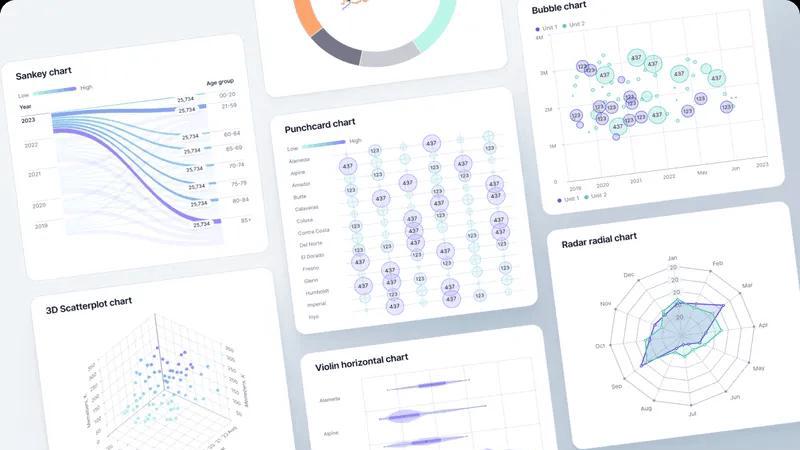
Fusedash consolidates dashboards, charts, maps, and narrative reporting into a single, cohesive platform. This eliminates the need to toggle between disparate tools, ensuring that all visualizations are built from the same consistent dataset and metric definitions. Teams can customize layouts, filters, and time ranges for different audiences, reusing the same core structure to maintain data integrity while tailoring the view for executives, marketing, or operations, thereby streamlining the entire reporting workflow.
AI-Powered Chart Generation
This feature allows users to rapidly generate clear, accurate visualizations directly from CSVs or connected APIs. The AI assists in selecting the optimal chart type, applying relevant comparisons, and refining labels to ensure the visual correctly conveys the underlying story. These charts can be used as standalone assets for presentations or seamlessly embedded into broader dashboards, significantly accelerating the initial data exploration and report-building process for analysts and business users alike.
Consistent Metric & KPI Governance
Fusedash enables organizations to formally define and standardize key metrics, dimensions, and calculations in a central repository. Once established, these certified definitions are automatically applied across every dashboard, chart, and report. This governance layer eradicates conflicting data stories, builds trust in the numbers, and ensures that every department is making decisions based on the same validated performance indicators, which is critical for strategic alignment.
Natural Language AI Chat for Data Exploration
Integrated Smart Chat allows users to interact with their data using plain language queries. Users can ask questions about trends, request specific breakdowns by segment or region, and receive intelligent suggestions for relevant metrics or visualizations. This conversational interface lowers the barrier to data analysis, enabling non-technical stakeholders to derive insights independently and instantly transform those insights into shareable, persistent dashboard views.
Perkoon
Unlimited Free P2P Transfers
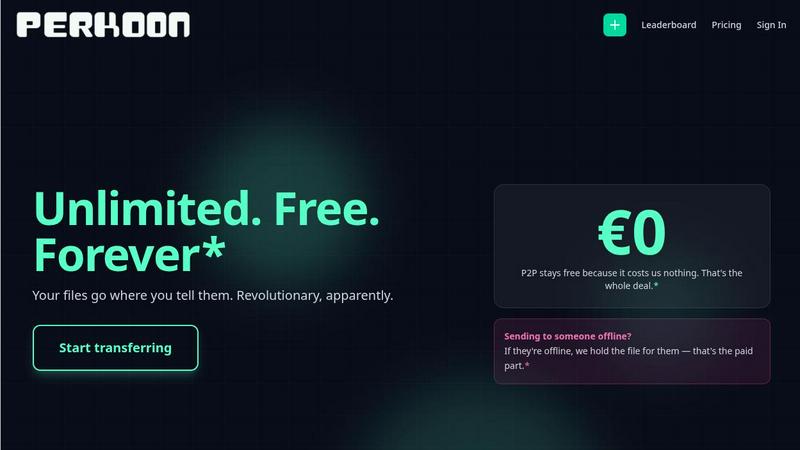
Perkoon's flagship feature utilizes WebRTC-based peer-to-peer technology to facilitate direct browser-to-browser file transfers. This method imposes no file size limits, requires no user accounts, and ensures maximum privacy and speed as data never transits a central server. For businesses, this means zero-cost transfer of large datasets, video productions, or software builds between online collaborators, directly reducing operational expenses associated with data egress and premium service tiers.
Encrypted Cloud Storage for Offline Recipients
When immediate transfer is not possible, Perkoon provides secure, encrypted cloud storage as a paid service. Files are held securely until the recipient is available, with pricing transparently covering server infrastructure costs. This hybrid model guarantees delivery reliability without forcing users into a one-size-fits-all subscription, allowing businesses to pay only for the storage and bandwidth they actually consume.
Native AI & Automation Integration
Unlike legacy services, Perkoon is built with machine-to-machine interaction as a first-class citizen. It exposes a dedicated JavaScript object (window.__perkoon) and CLI tools, enabling AI agents and automation scripts to interact with the service programmatically. This eliminates the need for unreliable DOM scraping, allowing enterprises to seamlessly integrate secure file transfer into CI/CD pipelines, automated reporting systems, and AI-driven content workflows.
Privacy-First Data Governance
Perkoon enforces a strict policy of non-interference with user data. P2P transfers are inherently private, and all cloud-stored files are encrypted. The company explicitly does not scan, analyze, or sell user data for advertising. This commitment provides legal and compliance teams with assurance regarding data sovereignty and adherence to stringent regulatory frameworks like GDPR, mitigating corporate risk.
Use Cases
Fusedash
Executive Performance Reporting
Leadership teams utilize Fusedash to create consolidated executive dashboards that provide a real-time, high-level view of organizational health. By combining financial, operational, and customer metrics into a single narrative report with storytelling sections, executives gain immediate context on what changed, why it matters, and what actions are recommended, reducing time spent in lengthy briefing meetings and enabling faster, data-driven strategic decisions.
Marketing Campaign Analysis
Marketing departments leverage the platform to monitor campaign performance across multiple channels in real time. They can build interactive dashboards to track KPIs like CAC, ROAS, and engagement, use the AI chart generator for rapid creative or segment performance analysis, and drill down into geographic data on maps to assess regional effectiveness. This unified view prevents data fragmentation between platforms and accelerates optimization cycles.
Operational Monitoring and Diagnostics
Operations and support teams use Fusedash for live monitoring of key processes and customer service metrics through real-time interfaces. When a KPI deviates, teams can immediately drill down into specific time periods, agent groups, or product lines to diagnose the root cause. This capability transforms monitoring from a passive alerting system into an active diagnostic tool, minimizing downtime and improving service quality.
Cross-Departmental Business Reviews
Fusedash serves as the central platform for quarterly and monthly business reviews (QBRs/MBRs). Instead of compiling conflicting slides from various departments, teams share a single, interactive Fusedash report. Each department can have its own filtered view within the same dataset, ensuring all discussions are based on consistent numbers, which streamlines preparation, enhances meeting productivity, and drives collective accountability.
Perkoon
Media Production & Creative Agencies
Teams regularly exchanging multi-gigabyte raw video footage, design files, and final renders between editors, clients, and external partners can utilize free P2P transfers for instantaneous review cycles. Cloud storage holds deliverables for client download on their schedule, eliminating costly overages from traditional transfer services and accelerating project timelines.
Software Development & DevOps
Development teams can integrate Perkoon's CLI and API into their deployment pipelines to automatically transfer build artifacts, log files, or database dumps between environments or to stakeholders. The native automation support ensures reliable, hands-off operation critical for agile development and continuous integration/continuous deployment (CI/CD) processes.
Legal & Financial Services Compliance
Firms handling sensitive client documents, audit trails, and confidential reports require secure transfer without third-party data mining. Perkoon's privacy-centric model, with encrypted cloud holds and P2P direct sends, provides a verifiable chain of custody and ensures that sensitive information remains protected throughout its lifecycle, supporting compliance mandates.
Enterprise IT & Infrastructure Management
IT departments can leverage Perkoon for cost-effective large-scale data distribution, such as deploying software packages, VM images, or backup archives across global offices. The ability to mix free P2P for internal transfers with on-demand cloud storage for external partners optimizes bandwidth costs and simplifies digital asset logistics.
Overview
About Fusedash
Fusedash is an enterprise-grade AI data visualization platform engineered to eliminate data silos and reporting inefficiencies that plague modern organizations. It provides a unified workspace where teams can transform raw, connected data from disparate sources into a single source of truth. The platform empowers users to create decision-ready dashboards, interactive charts, detailed maps, and narrative reports without the need to rebuild core logic across multiple, disconnected tools. Its foundational value proposition is consistency and operational efficiency: key metrics and KPIs are defined once and then reused across every view and report, ensuring alignment from leadership to frontline operations. Built for teams burdened by manual reporting cycles and conflicting data narratives, Fusedash not only enables real-time performance monitoring but also facilitates deep diagnostic analysis through intuitive drill-downs. Integrated AI capabilities, including natural language data chat and smart visualization assistance, democratize data exploration, making it faster and more accessible. By turning complex datasets into clear, actionable insights, Fusedash drives organizational alignment, accelerates decision-making, and delivers measurable ROI by drastically reducing the time spent on data wrangling and report generation.
About Perkoon
Perkoon is a next-generation file transfer platform engineered for business efficiency and uncompromising data sovereignty. It eliminates the friction, cost overhead, and privacy concerns endemic to traditional cloud services by leveraging a dual-architecture model. The platform is designed for professionals, teams, and enterprises that require a reliable, scalable, and cost-predictable method for exchanging digital assets, from large multimedia files to sensitive project documents. Its core value proposition is a transparent, utility-based pricing model: unlimited, free peer-to-peer (P2P) transfers for real-time exchanges, and fairly priced encrypted cloud storage for asynchronous delivery. This approach directly translates to significant ROI by removing per-user seat licenses and arbitrary file size caps that cripple productivity. Furthermore, Perkoon is architected for the modern automation stack, offering native API access and AI-agent compatibility, positioning it as critical infrastructure for streamlined, automated workflows without the security risks of screen-scraping.
Frequently Asked Questions
Fusedash FAQ
What types of data sources can I connect to Fusedash?
Fusedash offers flexible data integration capabilities designed for enterprise environments. You can start by uploading CSV files for quick analysis or connect directly to live data sources via API integrations, including databases, CRM platforms, marketing tools, and financial systems. The platform also allows you to combine multiple datasets into a single unified view and enrich your analysis with relevant public data, ensuring a comprehensive analytical foundation.
How does Fusedash ensure data consistency across different reports?
Consistency is a core architectural principle of Fusedash. The platform allows you to centrally define and manage your key metrics, dimensions, and calculation formulas. Once these "single sources of truth" are established, they are automatically applied to every dashboard, chart, and report built within the workspace. This governance model eliminates manual errors and definitional drift, guaranteeing that all teams across the organization are analyzing and reporting from the same trusted dataset.
Is the AI Chat feature suitable for non-technical business users?
Absolutely. The AI Chat (Smart Chat) feature is specifically designed to democratize data access. Users can ask questions about their data using natural, plain languageāfor example, "What were sales in the Northwest region last quarter?" or "Show me a breakdown of customer churn by product line." The AI interprets these queries, generates the appropriate analysis or visualization, and allows users to instantly save the results as a new view, making advanced analytics accessible without requiring SQL or technical expertise.
Can I use Fusedash for both real-time monitoring and static reporting?
Yes, Fusedash is built to support the full spectrum of data consumption needs. You can create real-time interfaces that refresh automatically to monitor live KPIs, such as website traffic or support ticket volume. Simultaneously, you can use the same connected data to build polished, narrative-driven reports for leadership, complete with storytelling context. This dual functionality ensures you have one platform for both operational vigilance and strategic communication.
Perkoon FAQ
How does Perkoon offer unlimited free P2P transfers?
The free P2P service is sustainable because it utilizes a direct connection between the sender's and recipient's web browsers. The file data never touches or is stored on Perkoon's servers, meaning the company incurs negligible infrastructure costs for this service. This cost-saving is passed directly to the user, allowing for truly unlimited, free transfers when both parties are online.
What happens if the recipient is not online when I send a file?
If the recipient is offline, the sender can opt to use Perkoon's Encrypted Cloud Storage. The file is securely uploaded and held on Perkoon's servers until the recipient is available to download it. This ensures guaranteed delivery. This is a paid feature, as it involves tangible server storage and bandwidth costs for Perkoon.
Is my data private and secure with Perkoon?
Yes. For P2P transfers, data is transmitted directly between browsers; Perkoon cannot see or access it. For files in cloud storage, they are encrypted at rest on Perkoon's servers. The company has a stated policy of no data scanning, analysis, or selling for advertising, ensuring your business data remains your own.
Can automated systems and AI agents use Perkoon?
Absolutely. Perkoon is designed for automation. It provides a native JavaScript API (window.__perkoon) accessible to browser-based AI agents and a Command Line Interface (CLI) tool. This allows scripts and autonomous agents to initiate and manage file transfers programmatically without the need for manual intervention or brittle screen-scraping techniques.
Alternatives
Fusedash Alternatives
Fusedash is an AI-powered business intelligence and data visualization platform. It consolidates disparate data sources into a unified workspace, enabling teams to build consistent, decision-ready dashboards and reports. The platform's core strength lies in creating a single source of truth, eliminating manual reporting cycles and conflicting data narratives across departments. Organizations may seek alternatives to Fusedash for various strategic reasons. Common drivers include specific budget constraints, the need for deeper integration with an existing enterprise tech stack, or requirements for highly specialized analytical functions not covered by a generalist platform. Evaluating the total cost of ownership and long-term scalability is also a frequent consideration. When assessing other solutions, key criteria should include the ability to maintain consistent metric definitions, support for real-time data exploration, and the overall efficiency gained in report creation and distribution. The ideal platform reduces time-to-insight, empowers non-technical users with self-service analytics, and provides robust security to protect sensitive business data.
Perkoon Alternatives
Perkoon is a modern file transfer solution within the productivity and management software category, distinguished by its peer-to-peer architecture and AI-native design. Organizations evaluate alternatives to Perkoon for several strategic reasons, including specific compliance requirements, the need for deeper enterprise integrations, or budget structures that favor per-user licensing over transactional cloud storage fees. The decision often hinges on aligning the tool's capabilities with broader IT infrastructure and long-term digital workflow strategies. When selecting a file transfer alternative, key evaluation criteria should include total cost of ownership, security and compliance certifications, and scalability. Beyond core functionality, consider the solution's ability to enhance team productivity through automation and its API maturity for connecting to existing business systems. The optimal choice minimizes friction in data exchange while maximizing operational efficiency and control.