
diffray vs qtrl.ai
Side-by-side comparison to help you choose the right AI tool.

diffray
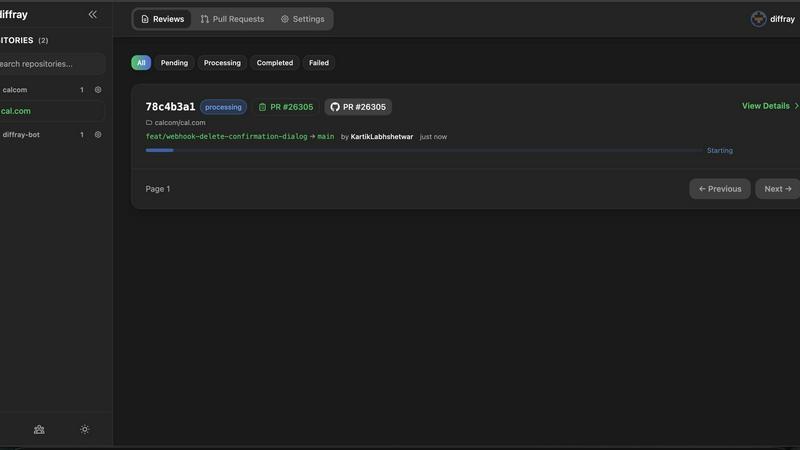
Enhance your coding efficiency with diffray's AI that detects real bugs while reducing false positives for superior.
Last updated: February 28, 2026

qtrl.ai
qtrl.ai scales QA with AI agents while ensuring full enterprise control and governance.
Last updated: March 4, 2026
Visual Comparison
diffray
qtrl.ai
Feature Comparison
diffray
Multi-Agent System
diffray’s standout feature is its multi-agent system, which utilizes over 30 specialized agents. Each agent focuses on a specific area of code quality, such as security, performance, and best practices, allowing for a more nuanced and effective review process.
Reduced False Positives
By employing multiple specialized agents, diffray significantly decreases the incidence of false positives in code reviews. This results in an 87% reduction in irrelevant alerts, allowing developers to focus on critical issues that truly impact code quality.
Faster Review Process
diffray streamlines the PR review workflow, cutting the average review time from 45 minutes to just 12 minutes per week. This significant reduction enhances productivity, enabling development teams to allocate more time to coding and less time to reviewing.
Comprehensive Code Analysis
The tool provides a thorough analysis of code quality, covering various aspects from security vulnerabilities to performance bottlenecks. This comprehensive review ensures that developers receive detailed feedback, which is crucial for maintaining high coding standards.
qtrl.ai
Enterprise-Grade Test Management
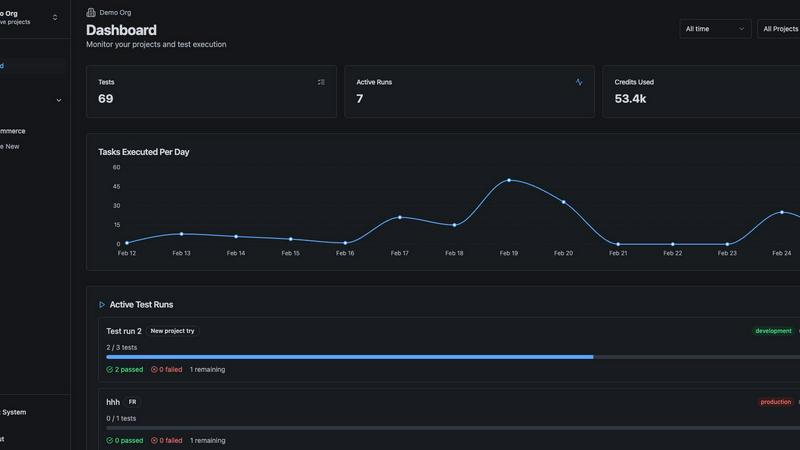
qtrl provides a centralized hub for all quality assurance activities, offering structured test case management, planning, and execution tracking. It ensures full traceability from requirements to test coverage, creating clear audit trails essential for compliance-driven environments. Teams can manage both manual and automated workflows within a single platform, providing engineering leads and QA managers with unparalleled visibility into testing status, pass/fail rates, and potential risk areas through real-time, customizable dashboards.
Progressive AI Automation & Autonomous Agents
Unlike all-or-nothing AI solutions, qtrl introduces intelligent automation progressively. Teams begin with human-written test instructions. When ready, they can leverage built-in autonomous AI agents that generate executable UI tests from plain English descriptions, maintain them as the application evolves, and run them at scale. This feature allows for a controlled adoption curve, where AI suggestions are fully reviewable and approvable, ensuring teams never lose oversight while significantly accelerating test creation and maintenance.
Governance by Design & Permissioned Autonomy
qtrl is built with enterprise trust and security as foundational principles. It offers configurable autonomy levels, ensuring AI agents operate strictly within user-defined rules and permissions. The platform provides full visibility into every agent action, eliminating "black-box" decisions. With enterprise-ready security, encrypted secrets management, and the guarantee that secrets are never exposed to AI agents, qtrl delivers the governance required for sensitive and regulated industries.
Adaptive Memory & Multi-Environment Execution
The platform's Adaptive Memory system builds a living, evolving knowledge base of your application by learning from every exploration, test execution, and resolved issue. This powers context-aware, smarter test generation over time. Coupled with robust multi-environment execution capabilities, teams can run tests across development, staging, and production environments with per-environment variables, ensuring consistency and reliability throughout the CI/CD pipeline.
Use Cases
diffray
Accelerated Development Cycles
Software development teams can leverage diffray to accelerate their development cycles. The significant reduction in PR review time allows teams to push code changes more frequently, leading to faster project completions and improved agility.
Enhanced Code Quality
With diffray's focus on specific code quality dimensions, teams can enhance the overall quality of their codebase. Developers receive targeted feedback that helps them address potential issues early in the development process, mitigating risks associated with code defects.
Improved Collaboration
diffray’s efficient review process fosters better collaboration among team members. By minimizing irrelevant alerts and focusing on actionable insights, developers can engage in more constructive discussions around code quality, leading to a more harmonious workflow.
Risk Mitigation
By identifying security vulnerabilities and performance issues early, diffray plays a critical role in risk mitigation. Development teams can address these concerns proactively, thereby reducing the likelihood of costly fixes post-deployment.
qtrl.ai
Scaling QA Beyond Manual Testing
For teams overwhelmed by repetitive manual test cycles, qtrl provides a structured path to automation. Teams can start by documenting manual test cases in the platform, then progressively use AI agents to automate the most time-consuming scripts. This use case directly translates to a measurable ROI by freeing QA personnel for higher-value exploratory testing and reducing time-to-market for new features without a steep initial learning curve.
Modernizing Legacy QA Workflows
Organizations reliant on outdated, siloed, or script-heavy automation frameworks can use qtrl to consolidate and modernize their entire QA process. The platform integrates with existing tools and requirements management systems, bringing test management, automation, and execution into a single, governed environment. This streamlines workflows, reduces maintenance costs of brittle scripts, and establishes a scalable foundation for continuous quality improvement.
Ensuring Governance in Regulated Enterprises
For enterprises in finance, healthcare, or government requiring strict compliance, audit trails, and change control, qtrl's governance-by-design approach is critical. The platform ensures full traceability for every requirement, test, and result, with permissioned autonomy that keeps AI actions accountable. This use case enables these organizations to leverage AI for productivity gains while fully meeting internal and external regulatory audit requirements.
Empowering Product-Led Engineering Teams
Product-led growth teams that deploy frequently need rapid, reliable quality feedback. qtrl integrates seamlessly into CI/CD pipelines, providing continuous quality feedback loops. Autonomous agents can be triggered on-demand to validate new builds or user journeys, ensuring that rapid iteration does not compromise software quality. This accelerates release velocity while providing engineering leads with confidence in each deployment.
Overview
About diffray
diffray is a revolutionary AI-driven code review tool meticulously crafted to enhance the workflow of software development teams. It transcends the limitations of conventional AI code review solutions by implementing a unique multi-agent system comprising over 30 specialized agents. Each agent is designed to assess a specific dimension of code quality, including security vulnerabilities, performance optimization, bug detection, adherence to best practices, and search engine optimization (SEO). This tailored approach minimizes irrelevant feedback in pull requests (PRs), achieving a remarkable 87% reduction in false positives while identifying three times more genuine issues. Consequently, diffray streamlines the PR review process, reducing the average review time from 45 minutes to an astonishing 12 minutes per week. This considerable efficiency gain positions diffray as an indispensable resource for developers aiming to elevate their coding standards and ensure timely, high-quality code delivery.
About qtrl.ai
qtrl.ai is an enterprise-grade AI-powered QA platform engineered to help software development teams scale their quality assurance operations while maintaining rigorous control and governance. It addresses the critical industry dilemma of choosing between the slow, unscalable nature of manual testing and the brittle, high-maintenance complexity of traditional test automation. qtrl provides a unified solution by combining robust, centralized test management with a progressive, trustworthy layer of AI automation. This platform serves as a single source of truth for organizing test cases, planning test runs, tracing requirements to coverage, and tracking real-time quality metrics through comprehensive dashboards. Its core value proposition is delivering a trusted path to faster release cycles and higher-quality software, making it ideal for product-led engineering teams, QA groups transitioning from manual processes, organizations modernizing legacy workflows, and enterprises with strict compliance and auditability requirements. qtrl's mission is to bridge the gap between control and speed, enabling teams to incrementally adopt intelligent automation without the risks associated with opaque, "black-box" AI solutions.
Frequently Asked Questions
diffray FAQ
What makes diffray different from other code review tools?
diffray stands out due to its multi-agent system that employs over 30 specialized agents, each focusing on specific aspects of code quality. This targeted approach leads to fewer false positives and more accurate issue identification.
How does diffray reduce review time so significantly?
By providing precise and actionable feedback through its specialized agents, diffray eliminates unnecessary noise in pull requests. This efficiency allows developers to conduct reviews in a fraction of the time typically required.
Can diffray integrate with existing development tools?
Yes, diffray is designed to seamlessly integrate with popular development tools and platforms, ensuring that teams can incorporate it into their existing workflows without disruption.
Is diffray suitable for teams of all sizes?
Absolutely. diffray is scalable and can benefit teams of any size, from small startups to large enterprises, by enhancing code quality and streamlining the development process.
qtrl.ai FAQ
How does qtrl.ai ensure the AI doesn't make unpredictable changes?
qtrl is built on a principle of "permissioned autonomy." AI agents do not make changes autonomously; they operate within strictly defined rules and levels of access set by the team. All AI-generated tests or modifications are presented as suggestions for human review and approval. This governance layer, combined with full visibility into every agent action, ensures predictability and maintains human-in-the-loop control at all times.
Can qtrl.ai integrate with our existing development and project management tools?
Yes, qtrl is designed for real-world workflows and offers built-in integrations for seamless operation within your existing tech stack. It supports requirements management integration, CI/CD pipeline tools, and other essential development software. This allows teams to maintain their current processes while centralizing and enhancing their QA activities within the qtrl platform, avoiding disruptive changes to established workflows.
Is qtrl.ai suitable for teams with no prior test automation experience?
Absolutely. qtrl is specifically designed for progressive adoption, making it an ideal starting point for teams new to automation. You can begin by using the platform solely for manual test management and collaboration. As the team becomes comfortable, you can leverage features like AI test generation from plain English, which lowers the technical barrier to entry and allows you to scale automation efforts at your own pace.
How does qtrl.ai handle sensitive data and security during testing?
Security is a cornerstone of qtrl's enterprise design. The platform supports per-environment variables and encrypted secrets for managing sensitive data like credentials and API keys. Crucially, these secrets are never exposed to the AI agents during test execution. qtrl also adheres to enterprise-grade security standards and offers detailed data processing agreements, making it a trustworthy choice for organizations with stringent security and privacy requirements.
Alternatives
diffray Alternatives
diffray is a cutting-edge AI-driven code review tool that enhances code quality through its innovative multi-agent architecture. This tool belongs to the development category and is designed to help software development teams improve their workflow by identifying real bugs while minimizing false positives. Users commonly seek alternatives to diffray for various reasons, including pricing considerations, specific feature requirements, or compatibility with existing platforms. When looking for an alternative, it is crucial to evaluate factors such as the architecture of the tool, the comprehensiveness of its feedback, and the overall impact on productivity and code quality.
qtrl.ai Alternatives
qtrl.ai is a modern QA and test automation platform designed for software engineering teams. It combines structured test management with intelligent AI agents to help teams scale their testing efforts while maintaining full governance and control over the process. This positions it within the broader categories of test automation and developer tools. Users often evaluate alternatives for several strategic reasons. These can include budget constraints, the need for specific niche features not covered by a general platform, or integration requirements with an existing toolchain. Some organizations may also prioritize different aspects, such as a heavier focus on open-source frameworks or a desire for a more developer-centric coding environment over a managed platform. When assessing alternatives, key considerations should align with core business objectives. Evaluate the total cost of ownership, not just licensing fees. Scrutinize the platform's approach to AI—whether it's transparent and governable or a black box. Finally, ensure it provides the necessary enterprise capabilities for security, compliance, and seamless integration into your development lifecycle to truly accelerate release velocity without introducing risk.