
claude ide vs Quitlo
Side-by-side comparison to help you choose the right AI tool.

claude ide
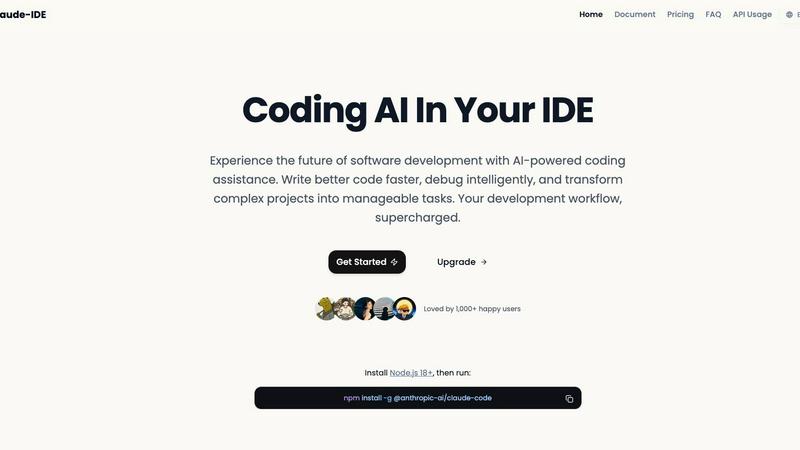
Claude IDE delivers enterprise-grade AI coding assistance that boosts developer productivity and accelerates project.
Last updated: March 1, 2026

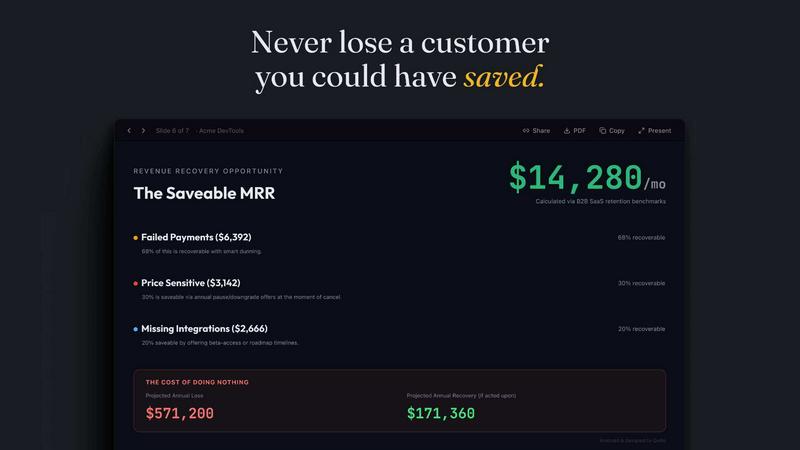
Quitlo uses AI voice calls to uncover the real reasons for churn, delivering actionable insights to your team.
Last updated: March 4, 2026
Visual Comparison
claude ide
Quitlo
Feature Comparison
claude ide
Intelligent Codebase Understanding
Claude IDE transcends simple snippet generation by comprehensively analyzing your entire project structure, architecture, and dependencies. This deep contextual awareness enables it to make coordinated, accurate changes across multiple files, offer relevant suggestions that fit the project's specific patterns, and explain complex codebases in seconds. This feature ensures that AI-assisted modifications maintain functionality and coherence, directly reducing the risk of errors and rework that can derail project timelines and increase technical debt.
Seamless IDE and Terminal Integration
The assistant operates natively within your existing workflow, embedding directly into the terminal and IDE interfaces like VS Code and JetBrains. This deep integration means developers can access powerful AI capabilities without ever leaving their primary coding environment. The elimination of constant application switching minimizes cognitive load and context loss, leading to a smoother, more focused development experience and a measurable increase in daily productive coding time.
End-to-End Development Workflow Management
Claude IDE is deeply integrated with GitHub, GitLab, and command-line tools to manage the complete software development lifecycle. It can read issues, write corresponding code, execute tests, and submit Pull Requests (PRs) all from within the terminal. This consolidation of tools streamlines project management, enforces workflow consistency, and significantly accelerates the process from bug report or feature request to deployed code, enhancing team velocity.
Powerful Multi-File Editing Capabilities
Leveraging its deep understanding of project context and dependencies, Claude IDE can execute sophisticated, multi-file edits with a single command. Whether it's refactoring a component, updating an API across multiple services, or implementing a new feature that touches several parts of the codebase, the assistant ensures changes are accurate and functionally sound. This capability empowers developers to undertake large-scale code improvements confidently and efficiently, improving overall code quality and maintainability.
Quitlo
Adaptive AI Voice Conversations
Quitlo's core feature is its AI-driven voice and text conversations that replace static surveys. When a churn signal is detected, the AI initiates a natural, two-minute dialogue, asking intelligent, empathetic follow-up questions based on the customer's initial response. This adaptive conversation uncovers the full story—context, sentiment, and underlying motives—that a dropdown menu or one-word answer never could, turning superficial feedback into deep, qualitative intelligence.
Automated Signal Detection & Triggers
The platform seamlessly integrates with your stack to automatically monitor and detect key customer lifecycle signals without manual intervention. It triggers conversations based on specific events like a user initiating cancellation, submitting a low CSAT/NPS score, a payment failure, post-onboarding silence, or for win-back campaigns. This ensures no critical moment for insight or recovery is missed, enabling proactive customer retention.
Structured, Actionable Intelligence Delivery
Within minutes of a conversation concluding, Quitlo synthesizes the dialogue into a concise, structured summary delivered to tools like Slack, Microsoft Teams, or Jira. This summary highlights the definitive churn reason, quantifies customer sentiment, flags competitor mentions, assesses the save opportunity (High/Medium/Low), and provides a suggested next action, enabling teams to act immediately with context.
Unified Churn Intelligence Across Five Entry Points
Quitlo operates through five integrated modules—Cancel Flows, Surveys, Payment Recovery, Check-Ins, and Win-Back—all powered by the same AI conversation engine. This provides a consistent methodology and intelligence output whether the signal comes from a cancellation, a survey, or a failed payment, creating a single source of truth for all churn-related customer insights across the organization.
Use Cases
claude ide
Rapid Codebase Onboarding and Auditing
For developers joining a new project or teams conducting code reviews, Claude IDE can instantly analyze and explain complex codebases. It provides high-level overviews of purpose, architecture, and key components, effectively compressing days of manual exploration into minutes. This accelerates the onboarding process for new hires and enables faster, more informed auditing and knowledge transfer, reducing the time to full productivity.
Automated Issue-to-PR Pipeline
Development teams can streamline their response to bug reports and feature requests. Claude IDE can read an issue from a connected repository, understand the required changes, write the corresponding code, run tests, and prepare a Pull Request—all within a continuous workflow. This automation drastically reduces manual overhead, minimizes human error in task handoff, and ensures faster turnaround times for critical fixes and updates.
Large-Scale Refactoring and Code Modernization
When a project requires significant refactoring, updating libraries, or modernizing architecture, Claude IDE manages the complexity of coordinated changes across numerous files. It understands the ripple effects of modifications, ensuring that updates are consistent and functional. This use case de-risks major technical initiatives, saves hundreds of developer hours, and allows teams to maintain modern, secure, and efficient codebases with less effort.
Intelligent Debugging and Problem Resolution
Developers can use Claude IDE as a first-line debugging partner. By providing error messages or describing unexpected behavior, the assistant can analyze the relevant code sections, understand the broader system context, and suggest precise fixes or explain root causes. This reduces mean time to resolution (MTTR) for bugs, decreases developer frustration, and frees senior engineers from routine debugging tasks to focus on more complex architectural challenges.
Quitlo
Recovering At-Risk Customers During Cancellation
When a customer clicks "cancel," Quitlo's smart cancel widget engages them with an optional AI voice conversation instead of a simple form. This real-time dialogue can uncover that "pricing" actually means "I'd stay with a team-tier plan," revealing a direct save opportunity that would otherwise be lost, allowing the CS team to intervene with a tailored offer before the churn is finalized.
Investigating Root Causes of Low NPS/CSAT Scores
For customers who provide a low promoter or satisfaction score, Quitlo automatically initiates a follow-up conversation. This moves beyond a mere number to understand the "why" behind the dissatisfaction, such as a specific missing integration or a frustrating UI element, providing product and success teams with direct, actionable feedback for improvement.
Recovering Revenue from Failed Payments
Instead of sending generic payment failure emails, Quitlo triggers an AI conversation with the cardholder. This personal touch can quickly determine if the issue is a simple expired card, a billing dispute, or a decision to cancel, dramatically increasing recovery rates by resolving issues proactively and saving otherwise salvageable accounts.
Conducting Post-Churn Win-Back Campaigns
Quitlo can automate win-back outreach to customers who churned 90 days prior. The AI engages them in a conversation to understand if their situation has changed—such as a new budget or dissatisfaction with a competitor—identifying potential candidates for re-activation with a high degree of precision, turning lost revenue into recovered ARR.
Overview
About claude ide
Claude IDE is an enterprise-grade AI coding assistant engineered to maximize developer productivity and accelerate software delivery cycles. It integrates directly into the terminal and popular Integrated Development Environments (IDEs) like Visual Studio Code and JetBrains, eliminating disruptive context switching. Powered by advanced models like Claude Opus 4.6, it provides deep, context-aware assistance that understands entire codebases, not just isolated snippets. This tool is designed for professional developers, engineering teams, students, and hobbyists who require professional-grade AI capabilities without enterprise-level costs. Its core value proposition is delivering a significant return on investment by reducing time spent on debugging, code familiarization, and repetitive tasks, thereby allowing developers to focus on high-value, complex problem-solving and feature development. By seamlessly integrating with version control systems and project workflows, Claude IDE transforms the development process into a more efficient, intelligent, and manageable operation.
About Quitlo
Quitlo is the first Churn Intelligence Platform engineered specifically for B2B SaaS companies. It directly addresses the critical revenue leak caused by inadequate customer feedback. Traditional methods like exit surveys and static cancel forms fail, delivering response rates below 8% and one-word, unactionable answers like "pricing." This leaves product, customer success, and growth teams guessing, unable to formulate effective retention strategies. Quitlo solves this by replacing passive forms with adaptive, empathetic AI conversations—conducted via both voice and text—that actively engage customers at pivotal moments across their lifecycle. The platform automatically detects churn signals such as a subscription cancellation, a low NPS score, or a failed payment, and initiates a genuine, two-minute dialogue. Its intelligent AI asks contextual follow-up questions to uncover the complete narrative behind the signal. Within minutes, a structured, actionable summary is delivered directly to operational hubs like Slack or Jira, detailing the precise churn reason, customer sentiment, competitor mentions, and clear save opportunities. For SaaS teams losing customers they don't understand, Quitlo transforms a single, vague data point into a concrete retention playbook, directly saving revenue and providing the strategic intelligence needed to improve product-market fit and customer experience.
Frequently Asked Questions
claude ide FAQ
How does Claude IDE differ from using the standard Claude chat interface?
Claude IDE is specifically engineered for software development, offering deep integration directly into your coding environment (terminal and IDE). Unlike a general chat interface, it has full context of your entire codebase, can execute commands, manage files, and interact with version control systems like Git. This specialized focus allows it to perform complex, multi-step development tasks such as coordinated refactoring and automated PR generation, which are beyond the scope of a standard conversational AI.
What are the system requirements for installing Claude IDE?
The primary requirement is having Node.js version 18 or higher installed on your system. Once Node.js is available, you can install Claude IDE globally via the npm package manager by running the command npm install -g @anthropic-ai/claude-code. This installs the CLI tool, which can then be integrated with your terminal and configured for use with supported IDEs like Visual Studio Code through appropriate extensions.
Can Claude IDE work with private or on-premise version control repositories?
Yes, Claude IDE is designed to integrate seamlessly with version control systems, including private repositories on platforms like GitHub and GitLab. It operates using your local Git configuration and credentials, allowing it to clone, read, and interact with your private codebases securely. For on-premise installations, it can connect to your internal Git servers as long as they are accessible from your development environment and you have the proper authentication configured.
Is my code secure when using Claude IDE?
Claude IDE is designed with a focus on local operation and developer privacy. The analysis and processing of your codebase are performed in the context of your own machine and development environment. It uses your local context to provide suggestions and does not arbitrarily send large volumes of proprietary source code to external servers for general processing. You maintain control over your intellectual property while leveraging the AI's analytical power.
Quitlo FAQ
How is Quitlo different from traditional exit surveys?
Traditional exit surveys rely on passive, static forms with low response rates and yield minimal, unactionable data like one-word answers. Quitlo actively engages customers with adaptive AI conversations (voice or text) that ask empathetic follow-up questions to uncover the full story, context, and sentiment behind their decision, delivering structured, actionable intelligence instead of just a data point.
What happens to the data from the AI conversations?
All conversation data is processed and synthesized into a clear, structured summary that is delivered to your designated tools like Slack or Jira. The summary includes the churn reason, sentiment analysis, competitor mentions, and a save opportunity score. Full transcripts are also available for review, ensuring teams have complete visibility while saving time on analysis.
Can Quitlo integrate with our existing tech stack?
Yes, Quitlo is built to integrate seamlessly with the core systems used by B2B SaaS teams. It connects with your subscription/billing platform (like Stripe, Chargebee), CRM (like Salesforce, HubSpot), communication tools (like Slack, Microsoft Teams), and support/issue tracking software (like Jira, Zendesk) to automate signal detection and intelligence delivery.
Is Quitlo a suitable replacement for Delighted?
Absolutely. Quitlo is designed as a direct and superior replacement for Delighted. It handles all traditional survey functions Delighted provided, and significantly enhances capability by adding proactive, AI-driven voice conversations to gather deep, contextual feedback at critical moments, transforming passive score collection into active churn intelligence and recovery.
Alternatives
claude ide Alternatives
Claude IDE is an AI-powered coding assistant designed to integrate directly into developer workflows within terminals and popular IDEs. It belongs to the category of AI development tools, which aim to enhance productivity by providing intelligent code suggestions, debugging, and project management assistance. Developers may seek alternatives for various strategic reasons. Common drivers include budget constraints, as pricing models and tiers vary significantly across the market. Others may require specific feature sets, such as support for niche programming languages or advanced team collaboration tools, that better align with their enterprise project requirements. Platform compatibility and the depth of integration with existing development ecosystems are also critical decision factors. When evaluating alternatives, businesses should prioritize solutions that deliver measurable ROI through enhanced developer velocity and reduced time-to-market. Key considerations include the tool's ability to understand complex, multi-file codebases, its security and data handling protocols, and the total cost of ownership. The ideal alternative should seamlessly integrate into the current tech stack without disrupting established workflows, thereby protecting productivity gains.
Quitlo Alternatives
Quitlo is a Churn Intelligence Platform in the AI Assistants and Customer Support categories. It uses adaptive AI conversations to replace ineffective surveys, uncovering the detailed reasons behind customer churn and delivering actionable insights directly to teams. Businesses may explore alternatives for various strategic reasons. Common drivers include budget constraints, the need for different integration capabilities, or a preference for a solution focused solely on survey analytics versus proactive conversation. Evaluating the total cost of ownership and specific workflow requirements is essential. When assessing an alternative, prioritize solutions that move beyond passive data collection. Look for platforms that actively engage customers, provide deep qualitative analysis, and seamlessly deliver intelligence into existing tools like Slack or CRM systems to drive immediate retention actions.