
Autheo
Autheo unifies identity, compute, storage, and AI into one interoperable blockchain OS to eliminate integration costs and scale Web2 and Web3.
Visit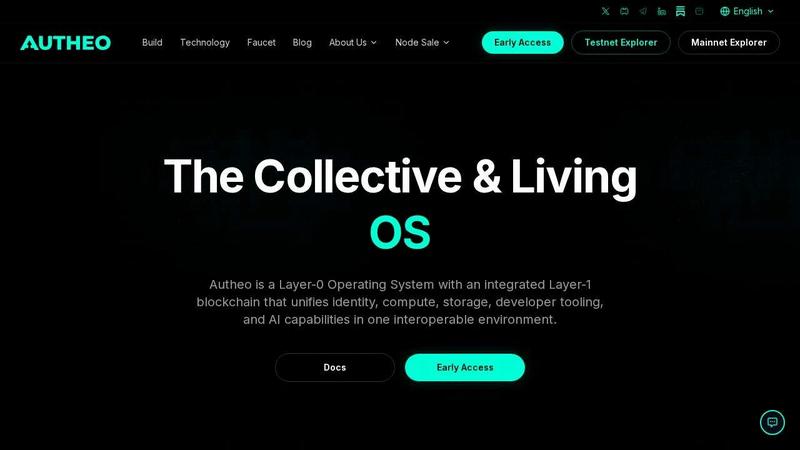
About Autheo
Autheo is a Layer-0 Operating System with an integrated Layer-1 blockchain designed to unify identity, compute, storage, developer tooling, and AI capabilities into one interoperable environment. It is built for developers, enterprises, and decentralized application builders who are frustrated by the fragmentation of Web3 infrastructure. The core problem Autheo solves is the costly, complex integration of multiple APIs, SDKs, and platforms that currently plague Web3 development. By providing a single, composable, programmable, and sovereign foundation, Autheo eliminates the gulf between Web2 and Web3, enabling projects to scale seamlessly across both worlds. The platform integrates six core components: a fast Layer-0 plus Layer-1 blockchain foundation, decentralized cloud infrastructure for compute and storage, full-stack SDKs for frontend and backend development, a native development environment called DevHub, TheoID for post-quantum secure authentication, and THEO AI for intelligent automation and adaptive workflows. Autheo is more than a technology stack; it is a living network where every deployment fuels the collective, and AI-native tools enable the system to learn, adapt, and evolve over time. With over 100 co-founders and contributors from blockchain, AI, gaming, and open-source backgrounds, Autheo represents a movement toward an intelligent, integrated internet where builders stop renting infrastructure and start owning a sovereign, self-optimizing digital environment. The platform is currently in early access, with a node sale underway for those looking to participate in the network's growth and validation.
Features of Autheo
Layer-0 and Layer-1 Blockchain Foundation
Autheo provides a fast, sovereign blockchain foundation that combines a Layer-0 operating system with an integrated Layer-1 chain. This architecture enables high throughput, low latency, and full interoperability across different applications and networks. Developers can launch their own sovereign chains or build directly on the main network without sacrificing performance or security. The dual-layer design solves the blockchain trilemma by balancing decentralization, security, and scalability, making it suitable for enterprise-grade applications that require both speed and trust.
Core Infrastructure for Decentralized Cloud
The platform includes a full suite of decentralized cloud services covering compute, storage, and messaging. This eliminates the need for third-party infrastructure providers and reduces operational complexity. Enterprises can deploy applications with guaranteed uptime, data integrity, and censorship resistance. The infrastructure is designed to scale automatically based on network demand, ensuring that projects can grow from prototype to global deployment without re-architecting their backend. This integrated approach reduces infrastructure costs by up to 40% compared to piecing together separate cloud and blockchain services.
Full-Stack SDKs and DevHub
Autheo offers a unified framework for frontend, backend, smart contract development, and application orchestration through its full-stack SDKs. The native DevHub environment provides a complete workspace for testing, deploying, and scaling projects without switching between multiple tools. Developers can write code once and deploy across Web2 and Web3 environments, dramatically reducing development time and integration costs. The SDKs include pre-built templates, debugging tools, and performance monitoring, enabling teams to ship production-ready applications 60% faster than traditional fragmented approaches.
TheoID and THEO AI
TheoID delivers post-quantum secure authentication and digital sovereignty for both people and digital assets. This future-proof security model protects against emerging quantum computing threats while giving users full control over their identities and data. THEO AI provides intelligent automation and adaptive workflows that learn from network interactions. As AI-native tools and agents join the stack, the platform continuously optimizes resource allocation, security protocols, and user experiences. Together, these features enable self-optimizing applications that become more efficient and intelligent over time.
Use Cases of Autheo
Enterprise Web3 Integration
Large enterprises seeking to bridge their existing Web2 systems with Web3 capabilities can use Autheo as a unified migration platform. The full-stack SDKs and DevHub environment allow enterprise development teams to build hybrid applications that leverage blockchain identity, decentralized storage, and smart contracts while maintaining compatibility with legacy systems. This reduces integration costs by eliminating the need for multiple middleware solutions and custom API bridges. Enterprises can achieve a 50% reduction in time-to-market for Web3 initiatives while maintaining enterprise-grade security and compliance standards.
Decentralized Identity and Authentication Systems
Organizations building secure identity solutions for digital assets, user authentication, or credential verification can leverage TheoID's post-quantum security. This use case is critical for financial services, healthcare, and government applications where identity theft and data breaches carry severe consequences. Autheo enables the creation of self-sovereign identity systems that users control, eliminating reliance on centralized identity providers. The platform supports millions of concurrent identity verifications with sub-second latency, making it viable for real-world, high-volume applications.
AI-Native Application Development
Developers building intelligent applications that require adaptive workflows, automated decision-making, and continuous learning can leverage THEO AI within Autheo's environment. The platform handles the orchestration of AI models, data storage, and blockchain interactions as a single system. This eliminates the complexity of integrating separate AI APIs, blockchain networks, and cloud services. Use cases include automated trading systems, supply chain optimization, personalized content delivery, and predictive maintenance for industrial IoT networks. Development teams report a 70% reduction in system integration effort compared to building with fragmented tools.
Sovereign Blockchain Networks
Teams looking to launch their own blockchain ecosystems can use Autheo's Layer-0 architecture to create sovereign chains with customized governance, tokenomics, and validation rules. This use case is ideal for gaming networks, decentralized finance protocols, and regional digital economies that require full control over their infrastructure. The platform provides pre-configured templates for common blockchain types, reducing the launch time from months to weeks. Each sovereign chain benefits from Autheo's shared security model and interoperability with other chains in the ecosystem, enabling cross-chain asset transfers and communication.
Frequently Asked Questions
What is Autheo?
Autheo is a Layer-0 Operating System with an integrated Layer-1 blockchain that unifies identity, compute, storage, developer tooling, and AI capabilities into one interoperable environment. It is designed to eliminate the fragmentation of Web3 development by providing a single foundation where developers and enterprises can build scalable applications, sovereign ecosystems, and interoperable networks without piecing together multiple platforms. The platform includes six core components: a blockchain foundation, decentralized cloud infrastructure, full-stack SDKs, a DevHub development environment, TheoID for secure authentication, and THEO AI for intelligent automation.
What can I build on Autheo?
You can build a wide range of applications including decentralized finance protocols, gaming networks, supply chain tracking systems, identity verification platforms, AI-powered automation tools, and hybrid Web2-Web3 enterprise applications. The platform supports sovereign blockchain networks, smart contract-based applications, and AI-native systems that learn and adapt over time. Because Autheo provides integrated compute, storage, and identity services, developers can build complex, multi-component systems without relying on external infrastructure providers or middleware solutions.
How is Autheo different from Ethereum or Solana?
Unlike Ethereum or Solana, which are primarily Layer-1 blockchain networks focused on smart contract execution, Autheo is a full operating system that includes a Layer-0 foundation for launching sovereign chains, integrated cloud infrastructure, developer tooling, identity management, and AI capabilities. Autheo is designed to be a complete environment for building and operating decentralized applications, not just a blockchain for executing transactions. It solves the fragmentation problem by providing all necessary components in one interoperable system, reducing the complexity and cost of multi-platform integrations.
Is Autheo live?
Autheo is currently in early access, with a testnet explorer and mainnet explorer available for developers to begin experimenting with the platform. The team is actively running a node sale program that allows participants to become validators on the network. The platform is being built by a team of over 100 co-founders and contributors from blockchain, AI, gaming, and open-source backgrounds. Developers interested in early access can sign up through the Autheo website to begin building on the platform and contributing to its evolution.
Similar to Autheo


Automate profitable 5-15 minute crypto arbitrage on Polymarket with a proven strategy that scaled $68 to $1.5M, running transparently via GitHub.


Bitcoin Loans Market enables you to effortlessly compare Bitcoin-backed loans, ensuring you select the best option tailored to your needs.

MadeOnSol is the central intelligence platform delivering Solana tool rankings, live KOL trade tracking, and developer APIs for enterprise-grade.


CreateMyCoin deploys production-ready Solana tokens in 60 seconds with zero coding and 40% lower fees.

Collab Chain transforms royalty statements into verifiable, tamper-evident proof of ownership and collaboration.