
Project20x vs TripleTen Burnout Test
Side-by-side comparison to help you choose the right AI tool.

Project20x
Project20x delivers AI governance that ensures compliance and drives measurable productivity gains.
Last updated: March 4, 2026

TripleTen Burnout Test
Quantify burnout risk and unlock a personalized plan to restore productivity and well-being.
Last updated: March 1, 2026
Visual Comparison
Project20x

TripleTen Burnout Test
Feature Comparison
Project20x
Governance Layer: AI-Powered Policy Analysis
This foundational layer employs a sophisticated ten-step AI methodology to assist lawmakers in crafting robust, clear, and conflict-free legislation. The AI analyzes draft legislative texts, identifying ambiguities, potential legal conflicts, and gaps in logic before policies are enacted. This proactive analysis de-risks the legislative process, reduces future compliance issues, and ensures policies are built on a sound, executable foundation from the outset, leading to more effective governance.
Management Layer: Rules as Code Automation
Once a policy is approved, the Management Layer automatically translates its natural language rules into functional, machine-executable code. This "Rules as Code" paradigm creates efficient, automated workflows for backend governmental operations. It eliminates manual interpretation errors, accelerates the deployment of new regulations, and enables real-time updates to systems, ensuring that public service management is as dynamic and precise as the policies it serves.
Interface Layer: 24/7 Citizen AI Agents
The Interface Layer provides citizens with direct, always-available access to AI agents trained on the codified policies. These agents can answer complex regulatory questions, guide users through application processes, and facilitate public service interactions without wait times. This feature dramatically improves citizen satisfaction and agency productivity by deflecting routine inquiries, allowing human staff to focus on high-value, exceptional cases.
End-to-End Transparency & Audit Framework
Project20x is built with an immutable audit trail, ensuring every automated decision, policy interaction, and workflow execution is fully traceable and quantifiable. This framework provides unparalleled transparency for oversight bodies and citizens alike, while maintaining rigorous human-in-the-loop controls for critical decisions. It turns governance into a data-driven function, enabling performance measurement and continuous improvement based on concrete metrics.
TripleTen Burnout Test
Comprehensive 5-Dimension Assessment
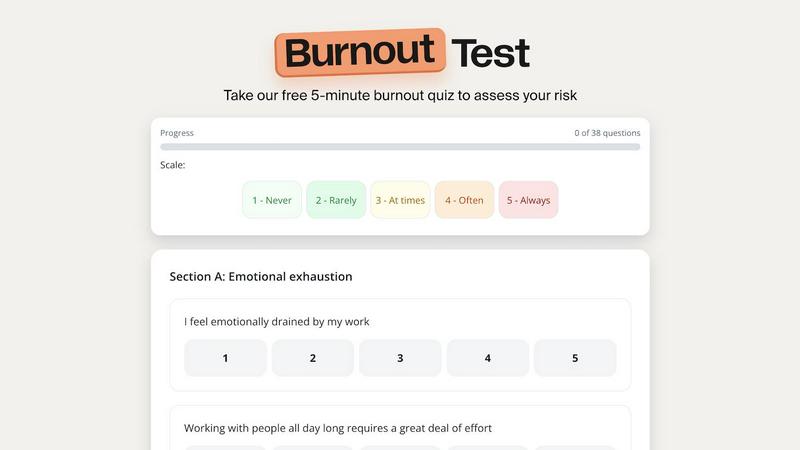
The test employs a rigorously structured 38-question framework that evaluates burnout risk across five validated domains: emotional exhaustion, cynicism, work performance, physical symptoms, and work-life balance. This multidimensional approach ensures a holistic diagnostic, moving beyond surface-level stress to identify the specific root causes and manifestations of burnout within an individual's professional experience, providing a complete picture of their well-being.
AI-Driven Personalized Recovery Plan
Upon completion, the platform's AI engine synthesizes the assessment data to generate a tailored, multi-stage recovery roadmap. This plan is not generic advice but a customized strategy aligned with the user's specific risk profile and scores across the five dimensions. It provides clear, actionable steps for immediate crisis management and long-term habit rebuilding, offering a structured path to sustainable recovery.
Immediate Diagnostic Clarity & Benchmarking
The tool delivers instant results, providing users and managers with immediate clarity on burnout risk levels. This rapid feedback loop eliminates prolonged uncertainty and enables swift, data-informed decision-making. Results can be benchmarked to understand severity, track progression over time, and measure the ROI of well-being interventions, transforming subjective feelings into quantifiable metrics.
Phased, Action-Oriented Framework
Guidance is structured around a proven three-phase recovery model: Recognition and Acceptance, Crisis Management, and Rebuilding and Prevention. This framework educates users on the recovery journey, providing stage-appropriate strategies. It empowers individuals to stabilize their situation, address core systemic or behavioral issues, and implement preventative habits, ensuring recovery leads to lasting change rather than a temporary reprieve.
Use Cases
Project20x
Streamlining Federal Grant Applications
Agencies like USAID or the Department of Education can use Project20x to codify complex grant eligibility rules and application procedures. The platform's AI agents provide instant, accurate guidance to applicants, while automated workflows pre-screen submissions for compliance. This reduces processing times from months to days, minimizes administrative errors, and ensures funds are distributed more efficiently and fairly.
Modernizing Regulatory Compliance for Businesses
The Department of Commerce can deploy Project20x to transform dense regulatory frameworks (e.g., export controls, trade regulations) into interactive digital services. Businesses can query an AI agent to understand specific compliance requirements for their scenario. This use case reduces the regulatory burden on industry, fosters economic growth, and allows agency compliance officers to leverage automated monitoring.
Accelerating Veteran Benefit Claims Processing
The Department of Veterans Affairs can implement the platform to automate the evaluation of benefit claims against codified eligibility statutes. The system can instantly verify service records, cross-reference medical criteria, and flag claims for human review only when necessary. This accelerates support to veterans, improves claim accuracy, and optimizes caseworker productivity.
Legislative Drafting and Impact Simulation
Lawmakers can utilize the Governance Layer as a collaborative drafting tool. As legislation is written, the AI simulates its impact by analyzing conflicts with existing laws and forecasting implementation challenges. This allows for data-informed policymaking, reduces unintended consequences, and creates legislation that is inherently easier and less costly for agencies to execute upon passage.
TripleTen Burnout Test
Proactive Organizational Health Screening
HR departments and people managers can deploy the test as a periodic wellness check to gauge team-wide burnout risk anonymously. This data identifies high-risk departments, informs targeted support programs, and measures the impact of cultural or policy changes. It serves as a leading indicator for talent retention and productivity, allowing leadership to address issues before they lead to costly turnover or disengagement.
Individual Career Sustainability Planning
Professionals feeling persistent fatigue or disengagement can use the test for self-diagnosis and actionable guidance. It helps individuals distinguish between temporary stress and clinical burnout, providing a confidential starting point for recovery. The personalized plan empowers them to have data-backed conversations with managers about workload, role adjustments, or necessary support, advocating for their well-being effectively.
Managerial Training and Team Support
Managers and team leads can utilize the tool to better understand the drivers of burnout within their teams. By recognizing the signs and risk factors, they can foster a more supportive environment, adjust workloads proactively, and provide resources aligned with the test's recovery framework. This builds psychological safety, improves team resilience, and enhances overall managerial effectiveness in sustaining performance.
Post-Intervention Recovery Tracking
For employees returning from stress-related leave or participating in wellness programs, the test offers a mechanism to track recovery progress objectively. By retaking the assessment at intervals, individuals and their support systems can measure improvements across the five dimensions, validate the effectiveness of chosen strategies, and adjust recovery plans dynamically to ensure a sustainable return to full capacity.
Overview
About Project20x
Project20x is an enterprise-grade, AI-native platform engineered to transform governmental efficiency and public engagement. It serves as a critical digital infrastructure for government agencies, lawmakers, and citizens, systematically bridging the gap between complex policy creation and its real-world implementation. The platform's core value proposition lies in its unique three-layer architecture, which translates legislative intent into automated, transparent, and measurable processes. By applying a rigorous ten-step AI methodology to policy development and pioneering "Rules as Code" for execution, Project20x directly addresses operational bottlenecks, reduces administrative overhead, and delivers quantifiable ROI through enhanced service delivery speed and accuracy. It ensures every governmental action is traceable, data-driven, and subject to human oversight, fundamentally modernizing governance for the 21st century with a focus on security, accountability, and citizen-centric design.
About TripleTen Burnout Test
The TripleTen Burnout Test is an enterprise-grade diagnostic tool designed to quantify and mitigate the significant productivity and financial risks associated with employee burnout. This comprehensive assessment provides a data-driven analysis of an individual's burnout risk across five critical dimensions: emotional exhaustion, cynicism, work performance, physical symptoms, and work-life balance. By completing a detailed 38-question evaluation, users receive an immediate, AI-powered analysis of their current state, moving beyond subjective feelings to objective, actionable insights. The core value proposition lies in its personalized recovery plan, which translates assessment results into a structured, phased strategy for sustainable recovery and prevention. For organizations, this tool serves as a crucial early-warning system, enabling proactive intervention to preserve institutional knowledge, reduce absenteeism and presenteeism, and protect the substantial investment in human capital. It is an indispensable resource for HR leaders, managers, and individual professionals committed to fostering a resilient, high-performing, and sustainable workforce.
Frequently Asked Questions
Project20x FAQ
How does Project20x ensure the security of sensitive government data?
Project20x is architected for the highest levels of government security requirements. It employs end-to-end encryption, strict access controls, and operates within government-certified cloud or on-premise environments. All data processing and AI training occur within a secure, sovereign boundary, with every access and action logged in the immutable audit framework to prevent and detect any unauthorized activity.
What is the implementation timeline and resource requirement for an agency?
Implementation is modular and scalable, typically beginning with a pilot on a specific regulatory process within 3-6 months. Project20x provides dedicated integration teams who work alongside agency subject matter experts to map and codify policies. The platform's AI-driven design reduces the heavy technical lift traditionally associated with IT modernization, allowing agencies to focus on policy logic rather than software development.
How does the platform handle changes or updates to existing policies?
The "Rules as Code" foundation makes policy updates highly efficient. When a law or regulation is amended, authorized personnel can update the central policy logic within the Management Layer. These changes are then propagated automatically across all connected workflows and AI agent knowledge bases, ensuring immediate and consistent application without needing to manually reprogram multiple disparate systems.
Can Project20x integrate with our agency's existing legacy systems?
Yes, a core design principle of Project20x is interoperability. The platform features robust APIs (Application Programming Interfaces) and integration adapters that allow it to connect securely with existing case management systems, databases, and citizen portals. This approach protects previous IT investments while layering on advanced automation and AI capabilities to modernize the entire service delivery chain.
TripleTen Burnout Test FAQ
How is the TripleTen Burnout Test different from a general stress quiz?
Unlike generic stress assessments, the TripleTen Burnout Test is a comprehensive diagnostic tool based on established psychological frameworks for measuring burnout syndrome. It evaluates five distinct, clinically relevant dimensions over 38 questions to provide a nuanced risk profile. The output includes a phased, personalized recovery plan with actionable strategies, making it a professional-grade tool for both diagnosis and intervention, rather than just awareness.
Is the test and its results kept confidential?
Absolutely. The test is designed as a personal diagnostic tool. Individual results are private and belong solely to the user. For organizational use cases, data should be aggregated and anonymized to provide team or department-level insights without compromising individual privacy. The tool empowers the user with knowledge to guide their own conversations and actions on their terms.
What should I do after receiving my personalized recovery plan?
Your plan is structured into three phases: Recognition, Crisis Management, and Rebuilding. Begin by implementing the immediate stabilization steps in the Crisis Management phase, such as setting boundaries and ensuring basic self-care. Then, systematically work through the Rebuilding phase to address root causes. Use the plan as a living document, revisiting it regularly and adapting the strategies as you progress and your situation evolves.
Can this tool help if I am already experiencing severe burnout?
Yes. The test is valuable at any stage. For severe burnout, the results will validate your experience, and the recovery plan will prioritize urgent crisis management steps, such as seeking professional medical or therapeutic help and taking necessary time off. It provides a structured framework to stop the downward spiral and begin the stabilization process, which is the critical first step toward long-term recovery.
Alternatives
Project20x Alternatives
Project20x is an enterprise-grade AI governance platform designed to translate complex regulatory policies into automated, compliant digital workflows. It belongs to the broader category of AI assistants and governance solutions that help organizations manage policy lifecycle and public engagement with precision and accountability. Organizations may seek alternatives to Project20x for various strategic reasons. Common drivers include budget constraints, specific feature requirements not covered by the core platform, or the need for integration with an existing legacy technology stack. Some may also prioritize different aspects of the implementation process or seek solutions with a narrower or broader functional scope. When evaluating an alternative AI governance solution, key considerations should include the platform's ability to ensure regulatory compliance, its methodology for translating policy into executable code, and the robustness of its security and audit protocols. Additionally, assess the total cost of ownership, scalability for future needs, and the level of human oversight and transparency provided throughout the automated process.
TripleTen Burnout Test Alternatives
The TripleTen Burnout Test is a sophisticated AI-driven assessment tool within the employee well-being and productivity category. It provides a five-dimension analysis of burnout risk and delivers a personalized, actionable recovery plan, empowering professionals and organizations to quantify and address workplace stress with data-driven insights. Users may explore alternatives for various strategic reasons. These include budget considerations, the need for integration with existing HR or wellness platforms, a preference for different delivery models like enterprise-wide deployments, or a requirement for more specialized features such as team-level analytics or longitudinal tracking of well-being metrics. When evaluating an alternative solution, key decision factors should include the scientific validity of the assessment, the depth and customizability of the resulting action plans, and the platform's ability to demonstrate a clear return on investment through measurable improvements in employee retention, engagement, and productivity. Security and data privacy compliance are also non-negotiable enterprise requirements.