Mia vs qtrl.ai
Side-by-side comparison to help you choose the right AI tool.
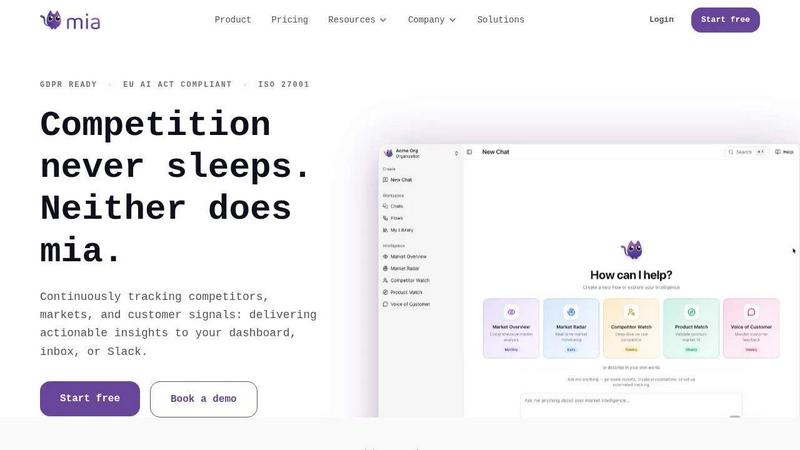
Mia delivers continuous AI-powered market intelligence to drive your growth strategy.
Last updated: March 4, 2026
qtrl.ai
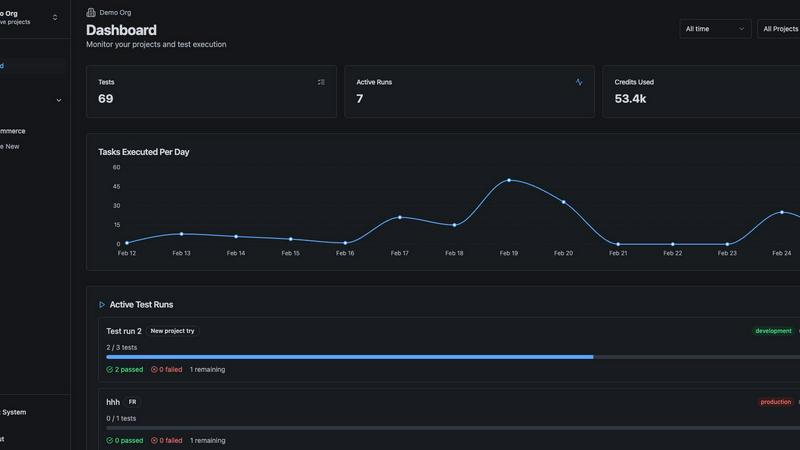
qtrl.ai scales QA with AI agents while ensuring full enterprise control and governance.
Last updated: March 4, 2026
Visual Comparison
Mia

qtrl.ai

Feature Comparison
Mia
Voice of Customer Analysis
This module aggregates and analyzes customer sentiment from diverse sources like reviews, social media, and support tickets. Using AI-powered analysis, it surfaces real-time feedback and trends, enabling product and customer success teams to prioritize their roadmap based on actual customer needs and pain points, moving beyond anecdotal evidence to data-driven decision-making.
Competitor Watch with Real-Time Alerts
Mia provides automated, continuous surveillance of your competitive landscape. It tracks competitors' product launches, feature updates, pricing changes, marketing campaigns, and public sentiment, delivering instant alerts to your preferred channel. This ensures your team never misses a critical move, allowing for proactive strategy adjustments to maintain competitive advantage.
AI-Powered Market Radar
Go beyond manual market research with continuous, AI-driven market intelligence. This feature scans for emerging trends, regulatory changes, technological shifts, and new market opportunities before they become mainstream. It transforms vast amounts of unstructured data into structured, actionable reports, giving your strategy team a consistent first-mover advantage.
One-Click Report Generation
Transform intelligence into executive-ready communication in seconds. Mia allows users to generate comprehensive, editable reports with a single click, which can be exported as PDF, Word, or presentation slides. This feature streamlines the process of sharing insights across the organization, from team meetings to board presentations, saving significant time and ensuring consistency.
qtrl.ai
Enterprise-Grade Test Management
qtrl provides a centralized hub for all quality assurance activities, offering structured test case management, planning, and execution tracking. It ensures full traceability from requirements to test coverage, creating clear audit trails essential for compliance-driven environments. Teams can manage both manual and automated workflows within a single platform, providing engineering leads and QA managers with unparalleled visibility into testing status, pass/fail rates, and potential risk areas through real-time, customizable dashboards.
Progressive AI Automation & Autonomous Agents
Unlike all-or-nothing AI solutions, qtrl introduces intelligent automation progressively. Teams begin with human-written test instructions. When ready, they can leverage built-in autonomous AI agents that generate executable UI tests from plain English descriptions, maintain them as the application evolves, and run them at scale. This feature allows for a controlled adoption curve, where AI suggestions are fully reviewable and approvable, ensuring teams never lose oversight while significantly accelerating test creation and maintenance.
Governance by Design & Permissioned Autonomy
qtrl is built with enterprise trust and security as foundational principles. It offers configurable autonomy levels, ensuring AI agents operate strictly within user-defined rules and permissions. The platform provides full visibility into every agent action, eliminating "black-box" decisions. With enterprise-ready security, encrypted secrets management, and the guarantee that secrets are never exposed to AI agents, qtrl delivers the governance required for sensitive and regulated industries.
Adaptive Memory & Multi-Environment Execution
The platform's Adaptive Memory system builds a living, evolving knowledge base of your application by learning from every exploration, test execution, and resolved issue. This powers context-aware, smarter test generation over time. Coupled with robust multi-environment execution capabilities, teams can run tests across development, staging, and production environments with per-environment variables, ensuring consistency and reliability throughout the CI/CD pipeline.
Use Cases
Mia
Accelerating Product Launches and Go-to-Market
Product and GTM teams use Mia to validate product-market fit, analyze competitor positioning, and monitor early customer signals pre- and post-launch. By providing continuous intelligence, Mia reduces market research cycles, identifies potential roadblocks early, and helps craft messaging that resonates, leading to a 30-50% faster and more successful market entry.
Dynamic Competitive Strategy Development
Strategy and leadership teams leverage Mia's Competitor Watch and Market Radar to move from reactive to proactive planning. By receiving automated alerts on competitor movements and market shifts, they can continuously refine business strategies, identify whitespace opportunities, and defend market share with confidence, directly contributing to revenue growth.
Data-Driven Product Roadmap Prioritization
Product managers utilize the Voice of Customer module to cut through the noise and identify the most critical features and fixes requested by users. By analyzing aggregated sentiment and feedback trends, they can build a roadmap aligned with actual customer demand, improving product satisfaction and reducing development waste on low-impact initiatives.
Enhancing Enterprise Market Intelligence Operations
Large enterprises employ Mia to scale their market intelligence function without proportional increases in headcount or cost. It serves as a unified platform that democratizes access to insights across departments—from marketing to sales to R&D—ensuring all teams operate from a single source of truth and can act on intelligence with speed.
qtrl.ai
Scaling QA Beyond Manual Testing
For teams overwhelmed by repetitive manual test cycles, qtrl provides a structured path to automation. Teams can start by documenting manual test cases in the platform, then progressively use AI agents to automate the most time-consuming scripts. This use case directly translates to a measurable ROI by freeing QA personnel for higher-value exploratory testing and reducing time-to-market for new features without a steep initial learning curve.
Modernizing Legacy QA Workflows
Organizations reliant on outdated, siloed, or script-heavy automation frameworks can use qtrl to consolidate and modernize their entire QA process. The platform integrates with existing tools and requirements management systems, bringing test management, automation, and execution into a single, governed environment. This streamlines workflows, reduces maintenance costs of brittle scripts, and establishes a scalable foundation for continuous quality improvement.
Ensuring Governance in Regulated Enterprises
For enterprises in finance, healthcare, or government requiring strict compliance, audit trails, and change control, qtrl's governance-by-design approach is critical. The platform ensures full traceability for every requirement, test, and result, with permissioned autonomy that keeps AI actions accountable. This use case enables these organizations to leverage AI for productivity gains while fully meeting internal and external regulatory audit requirements.
Empowering Product-Led Engineering Teams
Product-led growth teams that deploy frequently need rapid, reliable quality feedback. qtrl integrates seamlessly into CI/CD pipelines, providing continuous quality feedback loops. Autonomous agents can be triggered on-demand to validate new builds or user journeys, ensuring that rapid iteration does not compromise software quality. This accelerates release velocity while providing engineering leads with confidence in each deployment.
Overview
About Mia
Mia is an enterprise-grade, AI-powered market intelligence platform engineered to transform raw market data into strategic business growth. It is purpose-built for competitive organizations—from agile startups to established SMEs and large enterprises—that require real-time, actionable insights to outmaneuver competitors and capitalize on market opportunities. The platform operates as a continuous intelligence engine, automatically tracking competitors, market trends, and customer sentiment across multiple sources. It delivers these critical insights directly to users' dashboards, inboxes, or Slack, replacing weeks of manual research and enabling a 97% faster insight discovery process. Mia's core value proposition lies in its ability to provide a unified, compliant, and automated intelligence workflow, empowering growth, product, and strategy teams to make data-driven decisions that accelerate go-to-market by 30-50% and drive measurable revenue growth. With foundational commitments to data compliance, including GDPR, EU AI Act alignment, and ISO 27001 certification, Mia delivers transparent, trustworthy intelligence without compromising user privacy or security.
About qtrl.ai
qtrl.ai is an enterprise-grade AI-powered QA platform engineered to help software development teams scale their quality assurance operations while maintaining rigorous control and governance. It addresses the critical industry dilemma of choosing between the slow, unscalable nature of manual testing and the brittle, high-maintenance complexity of traditional test automation. qtrl provides a unified solution by combining robust, centralized test management with a progressive, trustworthy layer of AI automation. This platform serves as a single source of truth for organizing test cases, planning test runs, tracing requirements to coverage, and tracking real-time quality metrics through comprehensive dashboards. Its core value proposition is delivering a trusted path to faster release cycles and higher-quality software, making it ideal for product-led engineering teams, QA groups transitioning from manual processes, organizations modernizing legacy workflows, and enterprises with strict compliance and auditability requirements. qtrl's mission is to bridge the gap between control and speed, enabling teams to incrementally adopt intelligent automation without the risks associated with opaque, "black-box" AI solutions.
Frequently Asked Questions
Mia FAQ
How does Mia ensure data compliance and privacy?
Mia is built with a foundational commitment to data security and regulatory compliance. The platform is fully aligned with the General Data Protection Regulation (GDPR) and the EU AI Act, ensuring transparent data processing and ethical AI use. Furthermore, Mia is ISO 27001 certified, adhering to international standards for information security management, guaranteeing that all client data is handled with the highest levels of integrity and confidentiality.
What is the setup process like for Mia?
Setup is designed for speed and ease, requiring no technical expertise. Users simply input key information about their business, target market, and competitors they wish to track. This onboarding process takes minutes, not days. Once configured, Mia's AI begins its continuous monitoring and analysis immediately, delivering actionable insights to your chosen channels without any ongoing manual intervention required.
How does Mia differ from generic AI chatbots like ChatGPT?
Unlike general-purpose conversational AI, Mia is a specialized platform built exclusively for market and competitive intelligence. While generic AI requires manual prompting and research, Mia automates the entire intelligence lifecycle—from data collection to analysis to reporting. It offers built-in features like customer sentiment analysis, competitor tracking alerts, and one-click report generation that generic AI tools simply do not provide.
Can Mia integrate with our existing workflow tools?
Yes, Mia is designed for seamless integration into modern business workflows. It can deliver insights and automated alerts directly to popular collaboration platforms like Slack and Microsoft Teams, as well as to your email inbox. This ensures that critical intelligence reaches the right teams in the tools they already use daily, facilitating immediate awareness and action without platform switching.
qtrl.ai FAQ
How does qtrl.ai ensure the AI doesn't make unpredictable changes?
qtrl is built on a principle of "permissioned autonomy." AI agents do not make changes autonomously; they operate within strictly defined rules and levels of access set by the team. All AI-generated tests or modifications are presented as suggestions for human review and approval. This governance layer, combined with full visibility into every agent action, ensures predictability and maintains human-in-the-loop control at all times.
Can qtrl.ai integrate with our existing development and project management tools?
Yes, qtrl is designed for real-world workflows and offers built-in integrations for seamless operation within your existing tech stack. It supports requirements management integration, CI/CD pipeline tools, and other essential development software. This allows teams to maintain their current processes while centralizing and enhancing their QA activities within the qtrl platform, avoiding disruptive changes to established workflows.
Is qtrl.ai suitable for teams with no prior test automation experience?
Absolutely. qtrl is specifically designed for progressive adoption, making it an ideal starting point for teams new to automation. You can begin by using the platform solely for manual test management and collaboration. As the team becomes comfortable, you can leverage features like AI test generation from plain English, which lowers the technical barrier to entry and allows you to scale automation efforts at your own pace.
How does qtrl.ai handle sensitive data and security during testing?
Security is a cornerstone of qtrl's enterprise design. The platform supports per-environment variables and encrypted secrets for managing sensitive data like credentials and API keys. Crucially, these secrets are never exposed to the AI agents during test execution. qtrl also adheres to enterprise-grade security standards and offers detailed data processing agreements, making it a trustworthy choice for organizations with stringent security and privacy requirements.
Alternatives
Mia Alternatives
Mia is an AI-powered market intelligence platform in the competitive intelligence and strategic marketing category. It automates the tracking of competitors and market signals to deliver actionable insights, aiming to improve strategic decision-making and accelerate growth. Businesses explore alternatives for various strategic reasons. Common drivers include budget constraints and pricing model fit, the need for specific integrations with existing tech stacks like CRM or BI tools, or requirements for more specialized features such as advanced sentiment analysis or predictive analytics. The scale of operations, from startup to enterprise, also significantly influences platform selection. When evaluating alternatives, prioritize platforms that demonstrate clear ROI through time-to-insight and productivity metrics. Assess data compliance standards, the depth and transparency of insights, and the overall ease of implementation. The optimal solution should align with your company's growth stage and integrate seamlessly into your team's existing workflows without creating data silos.
qtrl.ai Alternatives
qtrl.ai is a modern QA and test automation platform designed for software engineering teams. It combines structured test management with intelligent AI agents to help teams scale their testing efforts while maintaining full governance and control over the process. This positions it within the broader categories of test automation and developer tools. Users often evaluate alternatives for several strategic reasons. These can include budget constraints, the need for specific niche features not covered by a general platform, or integration requirements with an existing toolchain. Some organizations may also prioritize different aspects, such as a heavier focus on open-source frameworks or a desire for a more developer-centric coding environment over a managed platform. When assessing alternatives, key considerations should align with core business objectives. Evaluate the total cost of ownership, not just licensing fees. Scrutinize the platform's approach to AI—whether it's transparent and governable or a black box. Finally, ensure it provides the necessary enterprise capabilities for security, compliance, and seamless integration into your development lifecycle to truly accelerate release velocity without introducing risk.