
Hostim.dev vs qtrl.ai
Side-by-side comparison to help you choose the right AI tool.

Hostim.dev
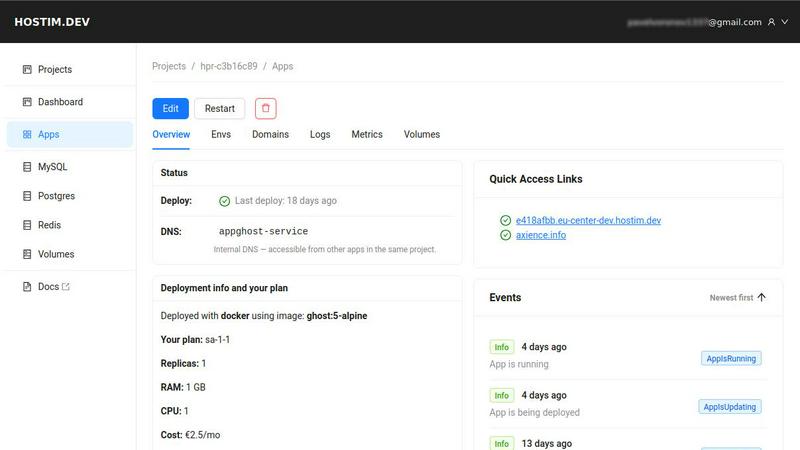
Hostim.dev deploys Docker apps with managed databases on EU infrastructure for predictable, compliant hosting.
Last updated: March 1, 2026

qtrl.ai
qtrl.ai scales QA with AI agents while ensuring full enterprise control and governance.
Last updated: March 4, 2026
Visual Comparison
Hostim.dev
qtrl.ai
Feature Comparison
Hostim.dev
Simplified Docker & Compose Deployment
Deploy full application stacks in minutes by simply pasting a Docker Compose file, pushing to a Git repository, or specifying a Docker image. This feature completely removes the need for complex YAML configuration or deep Kubernetes knowledge, reducing initial deployment setup time from hours to mere minutes and enabling rapid iteration and continuous delivery.
Built-in Managed Databases & Persistent Storage
Hostim.dev automatically provisions and seamlessly wires managed database instances (MySQL, PostgreSQL, Redis) and persistent volumes directly into your project's isolated environment. This eliminates the manual setup, security configuration, and ongoing maintenance of stateful services, ensuring high performance and data durability without operational burden.
EU Bare-Metal Hosting with GDPR Compliance
Applications are hosted on dedicated bare-metal servers within Germany, ensuring full GDPR compliance by default. This provides superior performance, data sovereignty, and regulatory peace of mind for businesses serving European customers, avoiding the latency and legal complexities associated with non-EU cloud providers.
Project-Centric Isolation & Transparent Billing
Each project runs in its own securely isolated Kubernetes namespace with automatic HTTPS, live metrics, and logging. Coupled with per-project cost tracking and transparent, flat-rate pricing, this allows for precise budgeting, clean client handovers, and accurate cost attribution, eliminating unexpected bills and financial overhead.
qtrl.ai
Enterprise-Grade Test Management
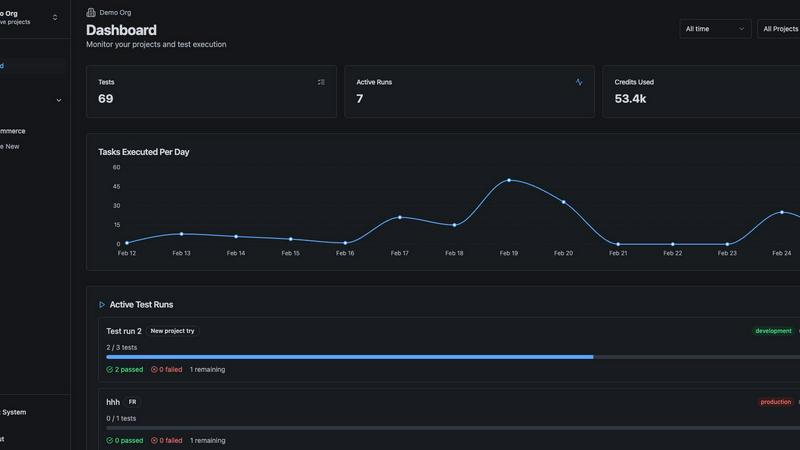
qtrl provides a centralized hub for all quality assurance activities, offering structured test case management, planning, and execution tracking. It ensures full traceability from requirements to test coverage, creating clear audit trails essential for compliance-driven environments. Teams can manage both manual and automated workflows within a single platform, providing engineering leads and QA managers with unparalleled visibility into testing status, pass/fail rates, and potential risk areas through real-time, customizable dashboards.
Progressive AI Automation & Autonomous Agents
Unlike all-or-nothing AI solutions, qtrl introduces intelligent automation progressively. Teams begin with human-written test instructions. When ready, they can leverage built-in autonomous AI agents that generate executable UI tests from plain English descriptions, maintain them as the application evolves, and run them at scale. This feature allows for a controlled adoption curve, where AI suggestions are fully reviewable and approvable, ensuring teams never lose oversight while significantly accelerating test creation and maintenance.
Governance by Design & Permissioned Autonomy
qtrl is built with enterprise trust and security as foundational principles. It offers configurable autonomy levels, ensuring AI agents operate strictly within user-defined rules and permissions. The platform provides full visibility into every agent action, eliminating "black-box" decisions. With enterprise-ready security, encrypted secrets management, and the guarantee that secrets are never exposed to AI agents, qtrl delivers the governance required for sensitive and regulated industries.
Adaptive Memory & Multi-Environment Execution
The platform's Adaptive Memory system builds a living, evolving knowledge base of your application by learning from every exploration, test execution, and resolved issue. This powers context-aware, smarter test generation over time. Coupled with robust multi-environment execution capabilities, teams can run tests across development, staging, and production environments with per-environment variables, ensuring consistency and reliability throughout the CI/CD pipeline.
Use Cases
Hostim.dev
Accelerating Startup MVP Launches
Startups can bypass costly and time-intensive infrastructure setup to deploy their minimum viable product (MVP) within a single day. By leveraging built-in databases and one-click deployments, small teams can validate market fit and iterate quickly, conserving capital and accelerating their path to revenue without technical debt.
Streamlining Agency Client Projects
Digital agencies can deploy and manage isolated application environments for each client directly from design specs or Docker Compose. Per-project billing provides clear, quotable costs for clients, while secure isolation and easy handover capabilities simplify project lifecycle management and improve profitability.
Enabling Enterprise Proof-of-Concepts
Enterprise development teams can rapidly spin up secure, compliant environments for testing new microservices, internal tools, or architecture prototypes. The platform's isolation and EU hosting meet corporate IT and compliance standards, allowing for risk-free innovation and faster decision-making cycles.
Facilitating Educational & Portfolio Development
Students and developers building portfolio projects gain access to real, production-like infrastructure with managed databases and deployment workflows. This practical experience with industry-standard tools accelerates learning and creates demonstrable work, enhancing employability without the cost barrier of traditional cloud platforms.
qtrl.ai
Scaling QA Beyond Manual Testing
For teams overwhelmed by repetitive manual test cycles, qtrl provides a structured path to automation. Teams can start by documenting manual test cases in the platform, then progressively use AI agents to automate the most time-consuming scripts. This use case directly translates to a measurable ROI by freeing QA personnel for higher-value exploratory testing and reducing time-to-market for new features without a steep initial learning curve.
Modernizing Legacy QA Workflows
Organizations reliant on outdated, siloed, or script-heavy automation frameworks can use qtrl to consolidate and modernize their entire QA process. The platform integrates with existing tools and requirements management systems, bringing test management, automation, and execution into a single, governed environment. This streamlines workflows, reduces maintenance costs of brittle scripts, and establishes a scalable foundation for continuous quality improvement.
Ensuring Governance in Regulated Enterprises
For enterprises in finance, healthcare, or government requiring strict compliance, audit trails, and change control, qtrl's governance-by-design approach is critical. The platform ensures full traceability for every requirement, test, and result, with permissioned autonomy that keeps AI actions accountable. This use case enables these organizations to leverage AI for productivity gains while fully meeting internal and external regulatory audit requirements.
Empowering Product-Led Engineering Teams
Product-led growth teams that deploy frequently need rapid, reliable quality feedback. qtrl integrates seamlessly into CI/CD pipelines, providing continuous quality feedback loops. Autonomous agents can be triggered on-demand to validate new builds or user journeys, ensuring that rapid iteration does not compromise software quality. This accelerates release velocity while providing engineering leads with confidence in each deployment.
Pricing Comparison
Hostim.dev
Hostim.dev employs a simple, transparent, and predictable pricing model starting from €2.50 per month. Billing is calculated on a per-project basis with hourly granularity, providing ultimate cost control. This flat pricing includes the application runtime, with free tiers available for managed database services (MySQL, PostgreSQL, Redis). There are no hidden fees for bandwidth, automatic HTTPS certificates, or basic monitoring, enabling accurate budgeting and straightforward cost quotation for client projects.
qtrl.ai
qtrl.ai offers a tiered pricing structure designed to support teams at different stages of their QA maturity journey. The "Start" plan is tailored for teams beginning to structure their QA process, offering core test management features. The "Scale" plan is for teams actively expanding their automation coverage, adding advanced AI agents and multi-environment execution. The "Optimize" plan provides full platform capabilities, including enterprise governance, advanced analytics, and premium support, for organizations requiring maximum control and scalability. For specific cost details, custom enterprise agreements, or to request a demo, visiting the official qtrl.ai website is recommended.
Overview
About Hostim.dev
Hostim.dev is an enterprise-grade, bare-metal Platform-as-a-Service (PaaS) engineered to eliminate DevOps overhead and accelerate time-to-market for containerized applications. It provides a streamlined, production-ready environment where developers can deploy directly from Docker images, Git repositories, or comprehensive Docker Compose files in minutes, not days. The platform automatically provisions and integrates essential managed services—including MySQL, PostgreSQL, Redis, and persistent storage—within a secure, isolated network per project. By abstracting the complexities of Kubernetes and infrastructure management, Hostim.dev delivers a significant return on investment by allowing engineering teams to refocus over 90% of their time from infrastructure maintenance to core product development and feature innovation. With transparent, per-project hourly billing starting at €2.5/month and GDPR-compliant hosting on EU bare-metal in Germany, it offers the control, predictability, and compliance required by serious businesses, startups, digital agencies, and SaaS companies prioritizing operational simplicity and financial transparency.
About qtrl.ai
qtrl.ai is an enterprise-grade AI-powered QA platform engineered to help software development teams scale their quality assurance operations while maintaining rigorous control and governance. It addresses the critical industry dilemma of choosing between the slow, unscalable nature of manual testing and the brittle, high-maintenance complexity of traditional test automation. qtrl provides a unified solution by combining robust, centralized test management with a progressive, trustworthy layer of AI automation. This platform serves as a single source of truth for organizing test cases, planning test runs, tracing requirements to coverage, and tracking real-time quality metrics through comprehensive dashboards. Its core value proposition is delivering a trusted path to faster release cycles and higher-quality software, making it ideal for product-led engineering teams, QA groups transitioning from manual processes, organizations modernizing legacy workflows, and enterprises with strict compliance and auditability requirements. qtrl's mission is to bridge the gap between control and speed, enabling teams to incrementally adopt intelligent automation without the risks associated with opaque, "black-box" AI solutions.
Frequently Asked Questions
Hostim.dev FAQ
What does the free tier include?
The platform offers a 5-day free trial project with no credit card required. This trial includes full access to deployment features (Docker, Git, Compose), built-in databases, persistent storage, automatic HTTPS, and project isolation. It is designed for complete evaluation of the platform's capabilities with your actual application stack.
Can I deploy with just a Docker Compose file?
Absolutely. Hostim.dev is built to accept a standard Docker Compose file as the primary deployment method. You can paste your docker-compose.yml directly into the dashboard, and the platform will automatically provision all defined services, networks, and volumes, launching your full multi-container application in minutes.
Where is my application hosted?
All applications on Hostim.dev are hosted on dedicated bare-metal servers in a secure, Tier III+ data center located in Germany. This ensures full GDPR compliance, superior performance through dedicated resources, and guarantees that all data remains within the European Union.
Do I need to know Kubernetes to use Hostim.dev?
No Kubernetes knowledge is required. Hostim.dev uses Kubernetes as a robust underlying orchestration layer but completely abstracts its complexity through a simplified developer interface. You interact only with Docker, Git, or Compose concepts, allowing you to benefit from Kubernetes' power without its operational learning curve.
qtrl.ai FAQ
How does qtrl.ai ensure the AI doesn't make unpredictable changes?
qtrl is built on a principle of "permissioned autonomy." AI agents do not make changes autonomously; they operate within strictly defined rules and levels of access set by the team. All AI-generated tests or modifications are presented as suggestions for human review and approval. This governance layer, combined with full visibility into every agent action, ensures predictability and maintains human-in-the-loop control at all times.
Can qtrl.ai integrate with our existing development and project management tools?
Yes, qtrl is designed for real-world workflows and offers built-in integrations for seamless operation within your existing tech stack. It supports requirements management integration, CI/CD pipeline tools, and other essential development software. This allows teams to maintain their current processes while centralizing and enhancing their QA activities within the qtrl platform, avoiding disruptive changes to established workflows.
Is qtrl.ai suitable for teams with no prior test automation experience?
Absolutely. qtrl is specifically designed for progressive adoption, making it an ideal starting point for teams new to automation. You can begin by using the platform solely for manual test management and collaboration. As the team becomes comfortable, you can leverage features like AI test generation from plain English, which lowers the technical barrier to entry and allows you to scale automation efforts at your own pace.
How does qtrl.ai handle sensitive data and security during testing?
Security is a cornerstone of qtrl's enterprise design. The platform supports per-environment variables and encrypted secrets for managing sensitive data like credentials and API keys. Crucially, these secrets are never exposed to the AI agents during test execution. qtrl also adheres to enterprise-grade security standards and offers detailed data processing agreements, making it a trustworthy choice for organizations with stringent security and privacy requirements.
Alternatives
Hostim.dev Alternatives
Hostim.dev is a specialized bare-metal Platform-as-a-Service (PaaS) designed to streamline the deployment of containerized applications. It eliminates DevOps overhead by offering one-click deployments from Docker or Git, integrated databases, and secure, EU-hosted infrastructure. This positions it as a powerful tool for developers and businesses seeking operational simplicity and predictable costs. Users may explore alternatives for various strategic reasons. These can include specific geographic hosting requirements outside the EU, the need for different pricing models like long-term commitments over transparent hourly billing, or a demand for a broader set of built-in services beyond MySQL, PostgreSQL, and Redis. Platform scalability and specific compliance certifications can also drive the evaluation of other solutions. When assessing an alternative platform, key considerations should align with business objectives. Evaluate the total cost of ownership, including hidden fees for data transfer or support. Scrutinize the deployment workflow's efficiency and its impact on developer productivity. Finally, ensure the platform's security posture, compliance standards, and reliability metrics meet your enterprise's risk management and operational continuity requirements.
qtrl.ai Alternatives
qtrl.ai is a modern QA and test automation platform designed for software engineering teams. It combines structured test management with intelligent AI agents to help teams scale their testing efforts while maintaining full governance and control over the process. This positions it within the broader categories of test automation and developer tools. Users often evaluate alternatives for several strategic reasons. These can include budget constraints, the need for specific niche features not covered by a general platform, or integration requirements with an existing toolchain. Some organizations may also prioritize different aspects, such as a heavier focus on open-source frameworks or a desire for a more developer-centric coding environment over a managed platform. When assessing alternatives, key considerations should align with core business objectives. Evaluate the total cost of ownership, not just licensing fees. Scrutinize the platform's approach to AI—whether it's transparent and governable or a black box. Finally, ensure it provides the necessary enterprise capabilities for security, compliance, and seamless integration into your development lifecycle to truly accelerate release velocity without introducing risk.