
Agent to Agent Testing Platform vs Project20x
Side-by-side comparison to help you choose the right AI tool.

Agent to Agent Testing Platform
Validate AI agent behavior across chat, voice, and multimodal systems to enhance security, compliance, and performance.
Last updated: February 26, 2026

Project20x
Project20x delivers AI governance that ensures compliance and drives measurable productivity gains.
Last updated: March 4, 2026
Visual Comparison
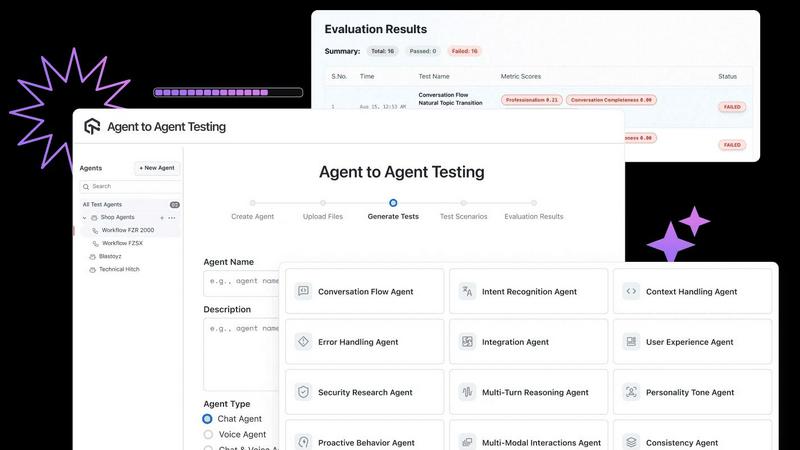
Agent to Agent Testing Platform
Project20x
Feature Comparison
Agent to Agent Testing Platform
Automated Scenario Generation
The platform features automated scenario generation that creates a diverse array of test cases for AI agents. This capability simulates interactions across chat, voice, hybrid, or phone caller scenarios, ensuring comprehensive coverage of potential user experiences.
True Multi-Modal Understanding
Agent to Agent Testing goes beyond mere text interactions. Users can define detailed requirements or upload various types of inputs, including images, audio, and video. This allows the platform to assess an AI agent’s responses in scenarios that closely mirror real-world conditions.
Diverse Persona Testing
Utilizing a variety of personas, the platform simulates different end-user behaviors and needs during testing. This ensures that AI agents perform effectively across diverse user types, including international callers and digital novices, enhancing their adaptability and effectiveness.
Regression Testing with Risk Scoring
The platform provides end-to-end regression testing capabilities that include insights into risk scoring. This feature highlights potential areas of concern within the AI agent's performance, allowing for prioritization of critical issues and optimization of testing efforts.
Project20x
Governance Layer: AI-Powered Policy Analysis
This foundational layer employs a sophisticated ten-step AI methodology to assist lawmakers in crafting robust, clear, and conflict-free legislation. The AI analyzes draft legislative texts, identifying ambiguities, potential legal conflicts, and gaps in logic before policies are enacted. This proactive analysis de-risks the legislative process, reduces future compliance issues, and ensures policies are built on a sound, executable foundation from the outset, leading to more effective governance.
Management Layer: Rules as Code Automation
Once a policy is approved, the Management Layer automatically translates its natural language rules into functional, machine-executable code. This "Rules as Code" paradigm creates efficient, automated workflows for backend governmental operations. It eliminates manual interpretation errors, accelerates the deployment of new regulations, and enables real-time updates to systems, ensuring that public service management is as dynamic and precise as the policies it serves.
Interface Layer: 24/7 Citizen AI Agents
The Interface Layer provides citizens with direct, always-available access to AI agents trained on the codified policies. These agents can answer complex regulatory questions, guide users through application processes, and facilitate public service interactions without wait times. This feature dramatically improves citizen satisfaction and agency productivity by deflecting routine inquiries, allowing human staff to focus on high-value, exceptional cases.
End-to-End Transparency & Audit Framework
Project20x is built with an immutable audit trail, ensuring every automated decision, policy interaction, and workflow execution is fully traceable and quantifiable. This framework provides unparalleled transparency for oversight bodies and citizens alike, while maintaining rigorous human-in-the-loop controls for critical decisions. It turns governance into a data-driven function, enabling performance measurement and continuous improvement based on concrete metrics.
Use Cases
Agent to Agent Testing Platform
Quality Assurance for Chatbots
Enterprises can leverage the platform to rigorously test chatbots before they go live. By simulating various user interactions, organizations can ensure their chatbots handle queries accurately and effectively, reducing the risk of customer dissatisfaction.
Voice Assistant Validation
The platform is instrumental in validating voice assistants' performance. It assesses how these AI agents respond to spoken commands and questions, ensuring they maintain high accuracy and professionalism in real-world applications.
Multimodal Experience Testing
Organizations developing AI solutions that integrate multiple input types can use the platform to test these multimodal experiences. This ensures that the AI agents provide consistent and relevant responses regardless of the input format, enhancing user engagement.
Compliance and Risk Management
With built-in validation features, the platform aids businesses in ensuring compliance with regulatory standards. By identifying potential policy violations and risk factors, enterprises can mitigate legal and operational risks associated with AI deployments.
Project20x
Streamlining Federal Grant Applications
Agencies like USAID or the Department of Education can use Project20x to codify complex grant eligibility rules and application procedures. The platform's AI agents provide instant, accurate guidance to applicants, while automated workflows pre-screen submissions for compliance. This reduces processing times from months to days, minimizes administrative errors, and ensures funds are distributed more efficiently and fairly.
Modernizing Regulatory Compliance for Businesses
The Department of Commerce can deploy Project20x to transform dense regulatory frameworks (e.g., export controls, trade regulations) into interactive digital services. Businesses can query an AI agent to understand specific compliance requirements for their scenario. This use case reduces the regulatory burden on industry, fosters economic growth, and allows agency compliance officers to leverage automated monitoring.
Accelerating Veteran Benefit Claims Processing
The Department of Veterans Affairs can implement the platform to automate the evaluation of benefit claims against codified eligibility statutes. The system can instantly verify service records, cross-reference medical criteria, and flag claims for human review only when necessary. This accelerates support to veterans, improves claim accuracy, and optimizes caseworker productivity.
Legislative Drafting and Impact Simulation
Lawmakers can utilize the Governance Layer as a collaborative drafting tool. As legislation is written, the AI simulates its impact by analyzing conflicts with existing laws and forecasting implementation challenges. This allows for data-informed policymaking, reduces unintended consequences, and creates legislation that is inherently easier and less costly for agencies to execute upon passage.
Overview
About Agent to Agent Testing Platform
Agent to Agent Testing Platform is an innovative AI-native quality assurance framework aimed at validating the behavior of AI agents in real-world environments. As AI systems become increasingly autonomous, traditional quality assurance methods fail to capture the dynamic interactions and unpredictability of these agents. This platform transcends conventional testing by facilitating comprehensive evaluations of multi-turn conversations across various modalities, including chat, voice, and phone interactions. Its primary user base includes enterprises looking to ensure the reliability and effectiveness of their AI agents before they are deployed in production. The platform's value proposition lies in its ability to uncover long-tail failures and edge cases, offering a robust testing environment that guarantees high performance while addressing critical metrics such as bias, toxicity, and hallucination.
About Project20x
Project20x is an enterprise-grade, AI-native platform engineered to transform governmental efficiency and public engagement. It serves as a critical digital infrastructure for government agencies, lawmakers, and citizens, systematically bridging the gap between complex policy creation and its real-world implementation. The platform's core value proposition lies in its unique three-layer architecture, which translates legislative intent into automated, transparent, and measurable processes. By applying a rigorous ten-step AI methodology to policy development and pioneering "Rules as Code" for execution, Project20x directly addresses operational bottlenecks, reduces administrative overhead, and delivers quantifiable ROI through enhanced service delivery speed and accuracy. It ensures every governmental action is traceable, data-driven, and subject to human oversight, fundamentally modernizing governance for the 21st century with a focus on security, accountability, and citizen-centric design.
Frequently Asked Questions
Agent to Agent Testing Platform FAQ
What types of AI agents can be tested using this platform?
The Agent to Agent Testing Platform can test various types of AI agents, including chatbots, voice assistants, and phone caller agents, across multiple interaction scenarios.
How does the platform ensure comprehensive coverage in testing?
The platform employs automated scenario generation to create diverse test cases, simulating a wide range of interactions that an AI agent may encounter in real-world environments.
Can I customize test scenarios for my AI agents?
Yes, users can access a library of pre-defined scenarios or create custom scenarios tailored to their specific needs, allowing for thorough evaluation of AI behavior.
What metrics can be evaluated during the testing process?
The platform evaluates critical metrics such as bias, toxicity, hallucinations, effectiveness, empathy, and professionalism, providing insights that enhance the overall performance of AI agents.
Project20x FAQ
How does Project20x ensure the security of sensitive government data?
Project20x is architected for the highest levels of government security requirements. It employs end-to-end encryption, strict access controls, and operates within government-certified cloud or on-premise environments. All data processing and AI training occur within a secure, sovereign boundary, with every access and action logged in the immutable audit framework to prevent and detect any unauthorized activity.
What is the implementation timeline and resource requirement for an agency?
Implementation is modular and scalable, typically beginning with a pilot on a specific regulatory process within 3-6 months. Project20x provides dedicated integration teams who work alongside agency subject matter experts to map and codify policies. The platform's AI-driven design reduces the heavy technical lift traditionally associated with IT modernization, allowing agencies to focus on policy logic rather than software development.
How does the platform handle changes or updates to existing policies?
The "Rules as Code" foundation makes policy updates highly efficient. When a law or regulation is amended, authorized personnel can update the central policy logic within the Management Layer. These changes are then propagated automatically across all connected workflows and AI agent knowledge bases, ensuring immediate and consistent application without needing to manually reprogram multiple disparate systems.
Can Project20x integrate with our agency's existing legacy systems?
Yes, a core design principle of Project20x is interoperability. The platform features robust APIs (Application Programming Interfaces) and integration adapters that allow it to connect securely with existing case management systems, databases, and citizen portals. This approach protects previous IT investments while layering on advanced automation and AI capabilities to modernize the entire service delivery chain.
Alternatives
Agent to Agent Testing Platform Alternatives
The Agent to Agent Testing Platform is an innovative AI-native quality assurance framework that ensures the reliability and compliance of AI agents across various communication channels, including chat, voice, and multimodal systems. This platform is essential for enterprises looking to validate AI behavior in real-world scenarios, particularly as these systems become increasingly autonomous and complex. Users often seek alternatives due to factors such as pricing, specific feature sets, or the need for a platform that better aligns with their organizational requirements. When evaluating alternatives, it is crucial to consider aspects like scalability, the ability to simulate real-world interactions, traceability, and the comprehensiveness of testing capabilities, as these factors can significantly impact the effectiveness of AI agent validation.
Project20x Alternatives
Project20x is an enterprise-grade AI governance platform designed to translate complex regulatory policies into automated, compliant digital workflows. It belongs to the broader category of AI assistants and governance solutions that help organizations manage policy lifecycle and public engagement with precision and accountability. Organizations may seek alternatives to Project20x for various strategic reasons. Common drivers include budget constraints, specific feature requirements not covered by the core platform, or the need for integration with an existing legacy technology stack. Some may also prioritize different aspects of the implementation process or seek solutions with a narrower or broader functional scope. When evaluating an alternative AI governance solution, key considerations should include the platform's ability to ensure regulatory compliance, its methodology for translating policy into executable code, and the robustness of its security and audit protocols. Additionally, assess the total cost of ownership, scalability for future needs, and the level of human oversight and transparency provided throughout the automated process.