
Rock Smith
Rock Smith is an AI QA tool that eliminates flaky tests to boost app reliability and developer productivity.
Visit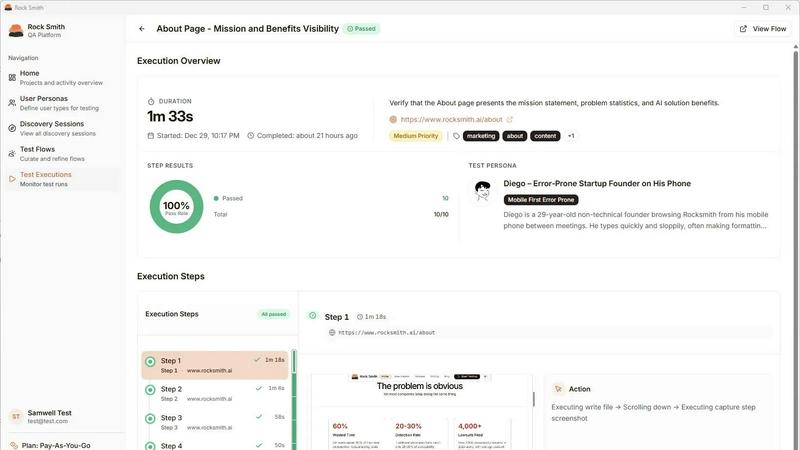
About Rock Smith
Rock Smith is an enterprise-grade AI-powered black box QA testing platform engineered to accelerate development velocity while ensuring robust application quality. It is designed for fast-moving engineering teams, including QA engineers, developers, and business leaders, who need to maintain a rapid release cadence without compromising on software reliability. The core value proposition lies in its revolutionary approach to test automation: by deploying autonomous AI agents that mimic real user behavior through semantic understanding, Rock Smith eliminates the dependency on brittle, code-level selectors like CSS and XPath. This allows test suites to automatically adapt to user interface changes, drastically reducing maintenance overhead by up to 70% and freeing engineering resources for feature development. Beyond basic automation, Rock Smith enhances test coverage with intelligent edge case generation and customizable test personas, ensuring comprehensive validation across diverse user scenarios. The platform delivers measurable ROI by shortening testing cycles, preventing costly post-release defects, and integrating secure, scalable testing practices directly into the CI/CD pipeline, transforming quality assurance from a development bottleneck into a strategic productivity multiplier.
Features of Rock Smith
Autonomous AI Testing Agents
Rock Smith utilizes advanced autonomous AI agents that intelligently navigate and interact with web applications just like a human user. These agents operate by understanding the semantic meaning and purpose of UI elements—such as "login button" or "checkout form"—rather than relying on fragile, line-of-code identifiers. This semantic targeting ensures tests remain functional and valid even after significant UI redesigns or code refactoring, slashing maintenance time and creating a truly resilient testing foundation for continuous deployment environments.
Semantic Element Targeting
This foundational feature enables Rock Smith's AI to identify and interact with application elements based on their visual context, textual labels, and functional role. By moving beyond traditional XPath and CSS selectors, the system creates tests that are inherently adaptable. When developers update a component's class or structure, Rock Smith's semantic engine still recognizes it as the "submit" button or "search" field, ensuring test stability and eliminating the need for constant, manual test script updates with every minor front-end change.
Intelligent Edge Case & Persona Generation
Rock Smith proactively strengthens application resilience by automatically generating and testing for complex edge cases and uncommon user journeys that are often missed in manual planning. Furthermore, QA teams can define and deploy specific "test personas"—simulated users with distinct behaviors, data, and permissions—to validate how the application performs for different user segments, such as a new visitor, a premium subscriber, or an admin, ensuring a comprehensive and user-centric quality assessment.
Integrated ROI & Security Analytics
The platform provides business leaders and engineering managers with clear, quantifiable metrics on testing efficiency, defect prevention, and time-to-market acceleration. Dashboards track key performance indicators like test stability, bug detection rate, and maintenance effort reduction, directly linking QA activity to business outcomes. All testing is conducted within a secure, controlled framework, ensuring sensitive data is never exposed and compliance requirements are met throughout the automated testing lifecycle.
Use Cases of Rock Smith
Accelerating CI/CD Pipeline Velocity
For engineering teams practicing continuous integration and deployment, Rock Smith integrates seamlessly to provide fast, reliable regression testing. Its self-healing, selector-free tests ensure that automated pipelines do not break due to UI changes, enabling teams to maintain high release frequency—from daily to multiple times per day—with confidence in the quality of each deployment, thereby directly supporting DevOps and Agile methodologies.
Reducing QA Maintenance Overhead
Organizations burdened by the high cost of maintaining thousands of flaky, selector-dependent automated tests can use Rock Smith to modernize their QA suite. By converting or building new tests with semantic AI, teams can reduce the time spent on test maintenance by up to 70%, reallocating valuable QA engineer and developer hours from script upkeep to strategic test design and exploratory testing of new features.
Ensuring Cross-Browser & Cross-Device Compatibility
Rock Smith's AI agents can be configured to execute test scenarios across a matrix of browser types, versions, and device resolutions. This automates the tedious process of ensuring consistent user experience, identifying rendering issues, functional discrepancies, or performance degradation specific to certain environments before they impact end-users, which is critical for customer-facing applications.
Validating Complex User Journeys and Business Logic
Beyond simple click-through tests, Rock Smith is adept at validating intricate multi-step workflows that involve dynamic data, conditional logic, and integrations with third-party services. This is ideal for testing critical business processes like e-commerce checkouts, financial transactions, or user onboarding sequences, ensuring all happy paths, unhappy paths, and system integrations function as designed under varied conditions.
Frequently Asked Questions
How does Rock Smith differ from traditional testing tools like Selenium?
Traditional tools like Selenium rely on developers or QA engineers to write scripts that target specific HTML elements using CSS selectors or XPaths, which are highly susceptible to breaking with any front-end code change. Rock Smith fundamentally differs by using AI to understand the application semantically. Its agents interact with the UI based on visual and contextual meaning, making tests far more resilient and adaptive, which drastically reduces maintenance and allows tests to be created more rapidly by describing user intent.
What is the implementation process for integrating Rock Smith?
Integration is designed for minimal disruption. Teams can start by connecting Rock Smith to their staging or development environment. The platform can observe user interactions to learn the application, or tests can be scripted using natural language commands. It connects to existing CI/CD tools (like Jenkins, GitHub Actions, or CircleCI) via API, allowing automated test suites to run as a step in the deployment pipeline. No major changes to the application code are required.
Can Rock Smith handle testing for single-page applications (SPAs) and dynamic content?
Yes, Rock Smith is particularly effective for modern web applications, including SPAs built with frameworks like React, Angular, or Vue.js. Its AI agents are engineered to wait for and understand dynamic content loading, state changes, and asynchronous updates. The semantic targeting model is inherently suited to applications where the DOM changes frequently without full page reloads, ensuring reliable interaction with modals, infinite scroll, and real-time updated components.
How does Rock Smith ensure the security of our application during testing?
Security is a core tenet of Rock Smith's design. The platform operates as a black-box solution, interacting only with the publicly accessible front-end of your application, just like a real user. It does not require access to source code, databases, or internal APIs. Sensitive test data can be managed through secure, masked variables, and all test execution occurs within isolated, controlled environments. This approach minimizes risk and aligns with enterprise security and compliance standards.
Pricing of Rock Smith
Rock Smith offers a tiered pricing model designed to scale with teams of all sizes, from solo founders to large enterprises. A free tier is available to try core features. The Solo Pro plan, priced at $10 per month (billed annually), is tailored for founders and solopreneurs, offering unlimited projects, custom AI experts, detailed implementation plans, and sharing capabilities. For growing startups and established teams, the Band plan supports collaboration for up to 5 human team members in addition to AI experts, featuring all Solo Pro benefits including the upcoming Spacewatcher market tracking tool. This structure allows organizations to begin with a low-risk investment and upgrade as their testing needs and team size expand, ensuring measurable ROI at every stage.