
HookMesh vs Hostim.dev
Side-by-side comparison to help you choose the right AI tool.

Effortlessly ensure reliable webhook delivery with HookMesh's automatic retries and self-service customer portal.
Last updated: February 26, 2026

Hostim.dev
Hostim.dev deploys Docker apps with managed databases on EU infrastructure for predictable, compliant hosting.
Last updated: March 1, 2026
Visual Comparison
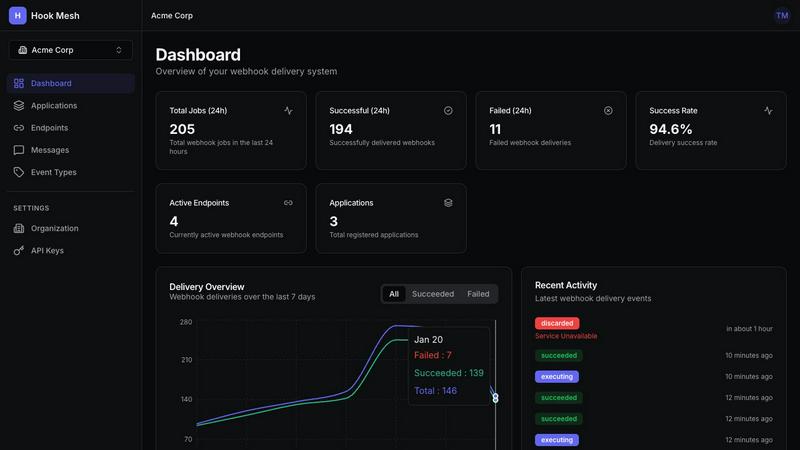
HookMesh
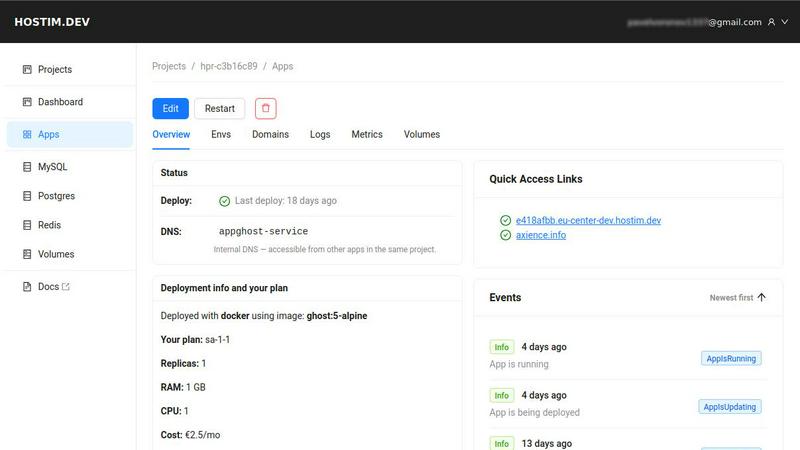
Hostim.dev
Feature Comparison
HookMesh
Reliable Delivery
HookMesh guarantees that no webhook will ever be lost. It incorporates automatic retries along with exponential backoff and jitter, which ensures that delivery attempts are made for up to 48 hours. This feature is critical for maintaining the integrity of data flow between applications.
Customer Portal
The self-service customer portal is an invaluable tool that allows users to manage their endpoints with ease. It provides an embeddable UI for endpoint management, delivery logs for full request/response visibility, and a one-click replay function to instantly retry failed deliveries, enhancing user experience and autonomy.
Developer Experience
HookMesh is designed with developers in mind, allowing them to ship webhooks in mere minutes. The REST API and official SDKs for JavaScript, Python, and Go provide full programmatic access. This streamlined integration process enables teams to send webhook events efficiently with minimal setup.
Comprehensive Visibility
With HookMesh, debugging delivery issues becomes straightforward. The platform provides complete visibility into webhook deliveries, allowing teams to track success and failures without having to sift through extensive logs. This transparency not only saves time but also enhances operational efficiency.
Hostim.dev
Simplified Docker & Compose Deployment
Deploy full application stacks in minutes by simply pasting a Docker Compose file, pushing to a Git repository, or specifying a Docker image. This feature completely removes the need for complex YAML configuration or deep Kubernetes knowledge, reducing initial deployment setup time from hours to mere minutes and enabling rapid iteration and continuous delivery.
Built-in Managed Databases & Persistent Storage
Hostim.dev automatically provisions and seamlessly wires managed database instances (MySQL, PostgreSQL, Redis) and persistent volumes directly into your project's isolated environment. This eliminates the manual setup, security configuration, and ongoing maintenance of stateful services, ensuring high performance and data durability without operational burden.
EU Bare-Metal Hosting with GDPR Compliance
Applications are hosted on dedicated bare-metal servers within Germany, ensuring full GDPR compliance by default. This provides superior performance, data sovereignty, and regulatory peace of mind for businesses serving European customers, avoiding the latency and legal complexities associated with non-EU cloud providers.
Project-Centric Isolation & Transparent Billing
Each project runs in its own securely isolated Kubernetes namespace with automatic HTTPS, live metrics, and logging. Coupled with per-project cost tracking and transparent, flat-rate pricing, this allows for precise budgeting, clean client handovers, and accurate cost attribution, eliminating unexpected bills and financial overhead.
Use Cases
HookMesh
E-commerce Transaction Notifications
For e-commerce platforms, timely notifications of transactions are crucial. HookMesh can manage webhook deliveries for order completions, refunds, and shipping updates, ensuring customers receive real-time updates and enhancing their overall shopping experience.
SaaS Product Integrations
SaaS companies can leverage HookMesh to integrate with third-party applications seamlessly. By managing webhook events for user sign-ups, upgrades, and cancellations, businesses can maintain engagement and streamline user interactions across platforms.
Automated Workflows
Businesses that rely on automated workflows can use HookMesh to trigger actions based on specific events. For example, when a lead is generated, a webhook can be sent to initiate follow-up processes automatically, improving efficiency and response times.
Event-Driven Architecture
Organizations adopting event-driven architecture can utilize HookMesh to facilitate communication between microservices. By ensuring reliable delivery of events, businesses can enhance system resilience and reduce downtime, ultimately leading to improved performance and customer satisfaction.
Hostim.dev
Accelerating Startup MVP Launches
Startups can bypass costly and time-intensive infrastructure setup to deploy their minimum viable product (MVP) within a single day. By leveraging built-in databases and one-click deployments, small teams can validate market fit and iterate quickly, conserving capital and accelerating their path to revenue without technical debt.
Streamlining Agency Client Projects
Digital agencies can deploy and manage isolated application environments for each client directly from design specs or Docker Compose. Per-project billing provides clear, quotable costs for clients, while secure isolation and easy handover capabilities simplify project lifecycle management and improve profitability.
Enabling Enterprise Proof-of-Concepts
Enterprise development teams can rapidly spin up secure, compliant environments for testing new microservices, internal tools, or architecture prototypes. The platform's isolation and EU hosting meet corporate IT and compliance standards, allowing for risk-free innovation and faster decision-making cycles.
Facilitating Educational & Portfolio Development
Students and developers building portfolio projects gain access to real, production-like infrastructure with managed databases and deployment workflows. This practical experience with industry-standard tools accelerates learning and creates demonstrable work, enhancing employability without the cost barrier of traditional cloud platforms.
Overview
About HookMesh
HookMesh is a groundbreaking platform designed to revolutionize webhook management for modern SaaS products. It simplifies the complexities associated with building and maintaining webhooks in-house, allowing businesses to focus on their core offerings. By addressing common challenges like retry logic, circuit breakers, and visibility into delivery issues, HookMesh empowers developers and product teams to deliver a reliable webhook experience effortlessly. The platform is built on battle-tested infrastructure that guarantees consistent delivery through features such as automatic retries, exponential backoff, and idempotency keys. This robust solution is ideal for organizations that prioritize customer satisfaction and want to avoid the technical headaches often linked to webhook management. With a self-service portal for end-users, HookMesh not only streamlines endpoint management but also enhances visibility and control, enabling users to replay failed webhooks with a single click. This makes HookMesh the definitive choice for teams aiming to optimize their webhook strategy and ensure seamless integration with their customers' systems.
About Hostim.dev
Hostim.dev is an enterprise-grade, bare-metal Platform-as-a-Service (PaaS) engineered to eliminate DevOps overhead and accelerate time-to-market for containerized applications. It provides a streamlined, production-ready environment where developers can deploy directly from Docker images, Git repositories, or comprehensive Docker Compose files in minutes, not days. The platform automatically provisions and integrates essential managed services—including MySQL, PostgreSQL, Redis, and persistent storage—within a secure, isolated network per project. By abstracting the complexities of Kubernetes and infrastructure management, Hostim.dev delivers a significant return on investment by allowing engineering teams to refocus over 90% of their time from infrastructure maintenance to core product development and feature innovation. With transparent, per-project hourly billing starting at €2.5/month and GDPR-compliant hosting on EU bare-metal in Germany, it offers the control, predictability, and compliance required by serious businesses, startups, digital agencies, and SaaS companies prioritizing operational simplicity and financial transparency.
Frequently Asked Questions
HookMesh FAQ
What is HookMesh?
HookMesh is a platform that simplifies webhook delivery management for SaaS products, providing features like automatic retries, a self-service customer portal, and robust visibility into delivery issues, allowing teams to focus on their core offerings.
How does HookMesh ensure reliable delivery?
HookMesh employs automatic retries with exponential backoff, circuit breakers to manage failing endpoints, and idempotency keys to guarantee that every webhook is delivered at least once, ensuring data integrity.
Can I manage endpoints easily with HookMesh?
Yes, HookMesh provides a self-service customer portal that allows users to manage their endpoints, view delivery logs, and replay failed webhooks with a single click, enhancing user autonomy and experience.
Is there a free tier available for HookMesh?
Yes, HookMesh offers a free tier that includes up to 5,000 webhooks per month, allowing users to experience core features without any upfront costs or credit card requirements.
Hostim.dev FAQ
What does the free tier include?
The platform offers a 5-day free trial project with no credit card required. This trial includes full access to deployment features (Docker, Git, Compose), built-in databases, persistent storage, automatic HTTPS, and project isolation. It is designed for complete evaluation of the platform's capabilities with your actual application stack.
Can I deploy with just a Docker Compose file?
Absolutely. Hostim.dev is built to accept a standard Docker Compose file as the primary deployment method. You can paste your docker-compose.yml directly into the dashboard, and the platform will automatically provision all defined services, networks, and volumes, launching your full multi-container application in minutes.
Where is my application hosted?
All applications on Hostim.dev are hosted on dedicated bare-metal servers in a secure, Tier III+ data center located in Germany. This ensures full GDPR compliance, superior performance through dedicated resources, and guarantees that all data remains within the European Union.
Do I need to know Kubernetes to use Hostim.dev?
No Kubernetes knowledge is required. Hostim.dev uses Kubernetes as a robust underlying orchestration layer but completely abstracts its complexity through a simplified developer interface. You interact only with Docker, Git, or Compose concepts, allowing you to benefit from Kubernetes' power without its operational learning curve.
Alternatives
HookMesh Alternatives
HookMesh is an advanced solution designed to streamline webhook delivery for Software as a Service (SaaS) products. By offering reliable delivery mechanisms, automatic retries, and a self-service customer portal, it alleviates the complexities involved in managing webhooks in-house. This allows businesses to focus on their core offerings without the burden of technical challenges associated with webhook management. Users often seek alternatives to HookMesh due to various reasons, including pricing, feature sets, and compatibility with existing platforms. When considering an alternative, it’s crucial to look for features such as reliability, customer support, ease of integration, and comprehensive analytics capabilities. These factors will help ensure that the chosen solution meets specific business needs while promoting operational efficiency.
Hostim.dev Alternatives
Hostim.dev is a specialized bare-metal Platform-as-a-Service (PaaS) designed to streamline the deployment of containerized applications. It eliminates DevOps overhead by offering one-click deployments from Docker or Git, integrated databases, and secure, EU-hosted infrastructure. This positions it as a powerful tool for developers and businesses seeking operational simplicity and predictable costs. Users may explore alternatives for various strategic reasons. These can include specific geographic hosting requirements outside the EU, the need for different pricing models like long-term commitments over transparent hourly billing, or a demand for a broader set of built-in services beyond MySQL, PostgreSQL, and Redis. Platform scalability and specific compliance certifications can also drive the evaluation of other solutions. When assessing an alternative platform, key considerations should align with business objectives. Evaluate the total cost of ownership, including hidden fees for data transfer or support. Scrutinize the deployment workflow's efficiency and its impact on developer productivity. Finally, ensure the platform's security posture, compliance standards, and reliability metrics meet your enterprise's risk management and operational continuity requirements.