
Fallom vs HookMesh
Side-by-side comparison to help you choose the right AI tool.

Fallom delivers real-time observability for LLMs, enhancing tracking, debugging, and cost management for AI operations.
Last updated: February 28, 2026

Effortlessly ensure reliable webhook delivery with HookMesh's automatic retries and self-service customer portal.
Last updated: February 26, 2026
Visual Comparison
Fallom
HookMesh
Feature Comparison
Fallom
Real-Time Observability
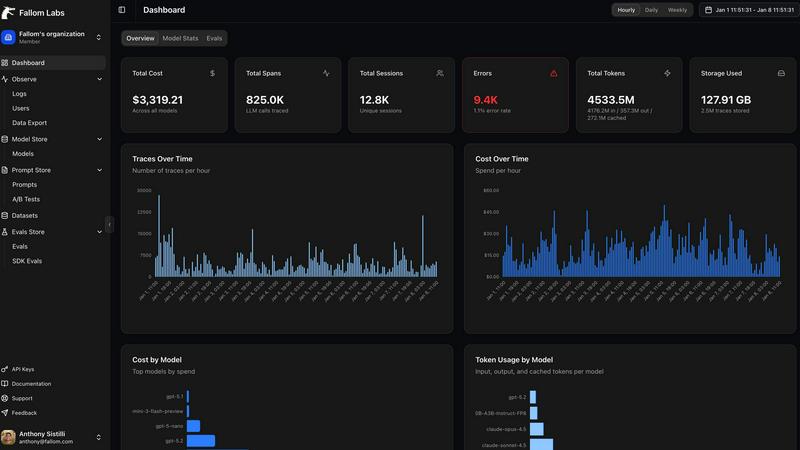
Fallom offers real-time observability for AI agents, allowing organizations to track tool calls, analyze execution timing, and debug performance issues with confidence. This transparency ensures that teams can identify bottlenecks and optimize workflows proactively.
Cost Attribution
With Fallom, businesses can track spending per model, user, and team, achieving full cost transparency for budgeting and chargeback purposes. This feature empowers organizations to manage their AI expenditures effectively and optimize resource allocation.
Compliance Ready
Fallom is equipped with comprehensive audit trails, ensuring organizations can meet regulatory requirements such as the EU AI Act, SOC 2, and GDPR. Features like input/output logging, model versioning, and user consent tracking help maintain compliance and support organizational accountability.
Session Tracking and Debugging
Fallom allows users to group traces by session, user, or customer, providing complete contextual visibility into interactions. This feature facilitates debugging and enhances the understanding of user behavior, enabling data-driven decision-making.
HookMesh
Reliable Delivery
HookMesh guarantees that no webhook will ever be lost. It incorporates automatic retries along with exponential backoff and jitter, which ensures that delivery attempts are made for up to 48 hours. This feature is critical for maintaining the integrity of data flow between applications.
Customer Portal
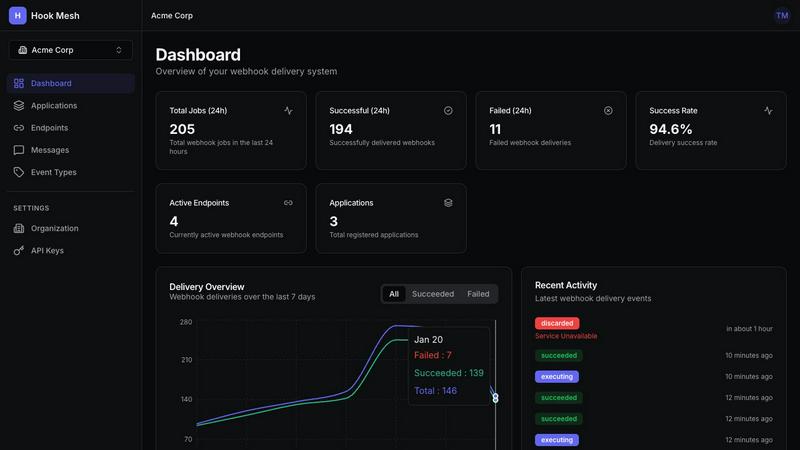
The self-service customer portal is an invaluable tool that allows users to manage their endpoints with ease. It provides an embeddable UI for endpoint management, delivery logs for full request/response visibility, and a one-click replay function to instantly retry failed deliveries, enhancing user experience and autonomy.
Developer Experience
HookMesh is designed with developers in mind, allowing them to ship webhooks in mere minutes. The REST API and official SDKs for JavaScript, Python, and Go provide full programmatic access. This streamlined integration process enables teams to send webhook events efficiently with minimal setup.
Comprehensive Visibility
With HookMesh, debugging delivery issues becomes straightforward. The platform provides complete visibility into webhook deliveries, allowing teams to track success and failures without having to sift through extensive logs. This transparency not only saves time but also enhances operational efficiency.
Use Cases
Fallom
Enhancing Debugging Processes
Organizations can leverage Fallom to streamline their debugging processes by tracing every function call, argument, and result in their agents. This visibility reduces the time spent on identifying and resolving issues within LLM workflows.
Budget Management and Cost Control
Fallom's cost attribution feature is ideal for finance teams that need to monitor and control AI-related expenditures. By tracking costs associated with each model and user, businesses can make informed decisions about their AI investments.
Regulatory Compliance Management
For businesses operating in regulated industries, Fallom provides the necessary tools to maintain compliance with audit trails and privacy controls. This ensures that organizations can operate confidently while adhering to stringent legal requirements.
Performance Evaluation and Optimization
Fallom enables organizations to run evaluations on LLM outputs, allowing teams to catch regressions before production. This capability helps maintain high-quality outputs and optimizes the overall performance of AI models.
HookMesh
E-commerce Transaction Notifications
For e-commerce platforms, timely notifications of transactions are crucial. HookMesh can manage webhook deliveries for order completions, refunds, and shipping updates, ensuring customers receive real-time updates and enhancing their overall shopping experience.
SaaS Product Integrations
SaaS companies can leverage HookMesh to integrate with third-party applications seamlessly. By managing webhook events for user sign-ups, upgrades, and cancellations, businesses can maintain engagement and streamline user interactions across platforms.
Automated Workflows
Businesses that rely on automated workflows can use HookMesh to trigger actions based on specific events. For example, when a lead is generated, a webhook can be sent to initiate follow-up processes automatically, improving efficiency and response times.
Event-Driven Architecture
Organizations adopting event-driven architecture can utilize HookMesh to facilitate communication between microservices. By ensuring reliable delivery of events, businesses can enhance system resilience and reduce downtime, ultimately leading to improved performance and customer satisfaction.
Overview
About Fallom
Fallom is a cutting-edge AI-native observability platform specifically designed to enhance the performance and management of large language models (LLMs) and agent workloads. By offering organizations unparalleled visibility into every LLM call made in production, Fallom enables comprehensive end-to-end tracing that includes critical components such as prompts, outputs, tool calls, tokens, latency, and cost per call. This platform is tailored for businesses requiring robust observability tools to navigate the complexities of AI operations, ensuring that teams can monitor usage in real-time, debug issues swiftly, and effectively allocate spending across various models, users, and teams. Additionally, Fallom provides essential session, user, and customer-level context, which is particularly vital for organizations operating in regulated environments. This includes delivering enterprise-ready audit trails, logging, model versioning, and consent tracking to meet compliance standards. With a single OpenTelemetry-native SDK, teams can instrument their applications within minutes, making Fallom an indispensable tool for organizations aiming to boost their LLM operational efficiency and compliance readiness.
About HookMesh
HookMesh is a groundbreaking platform designed to revolutionize webhook management for modern SaaS products. It simplifies the complexities associated with building and maintaining webhooks in-house, allowing businesses to focus on their core offerings. By addressing common challenges like retry logic, circuit breakers, and visibility into delivery issues, HookMesh empowers developers and product teams to deliver a reliable webhook experience effortlessly. The platform is built on battle-tested infrastructure that guarantees consistent delivery through features such as automatic retries, exponential backoff, and idempotency keys. This robust solution is ideal for organizations that prioritize customer satisfaction and want to avoid the technical headaches often linked to webhook management. With a self-service portal for end-users, HookMesh not only streamlines endpoint management but also enhances visibility and control, enabling users to replay failed webhooks with a single click. This makes HookMesh the definitive choice for teams aiming to optimize their webhook strategy and ensure seamless integration with their customers' systems.
Frequently Asked Questions
Fallom FAQ
What is Fallom used for?
Fallom is used for enhancing visibility and observability in large language model operations, enabling organizations to monitor, debug, and optimize AI workloads effectively.
How does Fallom ensure compliance with regulations?
Fallom ensures compliance by providing comprehensive audit trails, input/output logging, model versioning, and user consent tracking, making it suitable for organizations in regulated industries.
Can Fallom integrate with existing AI infrastructures?
Yes, Fallom utilizes a single OpenTelemetry-native SDK that is compatible with various AI providers, ensuring seamless integration into existing systems without vendor lock-in.
How quickly can teams get started with Fallom?
Teams can set up Fallom in under five minutes, allowing organizations to start tracing and monitoring their AI agents almost immediately, boosting productivity from the outset.
HookMesh FAQ
What is HookMesh?
HookMesh is a platform that simplifies webhook delivery management for SaaS products, providing features like automatic retries, a self-service customer portal, and robust visibility into delivery issues, allowing teams to focus on their core offerings.
How does HookMesh ensure reliable delivery?
HookMesh employs automatic retries with exponential backoff, circuit breakers to manage failing endpoints, and idempotency keys to guarantee that every webhook is delivered at least once, ensuring data integrity.
Can I manage endpoints easily with HookMesh?
Yes, HookMesh provides a self-service customer portal that allows users to manage their endpoints, view delivery logs, and replay failed webhooks with a single click, enhancing user autonomy and experience.
Is there a free tier available for HookMesh?
Yes, HookMesh offers a free tier that includes up to 5,000 webhooks per month, allowing users to experience core features without any upfront costs or credit card requirements.
Alternatives
Fallom Alternatives
Fallom is an advanced AI-native observability platform specifically designed for large language models (LLM) and agent workloads. It provides real-time visibility into LLM operations, enabling organizations to track, debug, and manage costs efficiently across their AI initiatives. As businesses increasingly adopt AI technologies, users often seek alternatives to Fallom for various reasons, including pricing structure, specific feature sets, or the need for integration with existing platforms. When evaluating alternatives, it is essential to consider factors such as functionality, ease of use, compliance capabilities, and overall return on investment to ensure the chosen solution meets organizational needs. In the rapidly evolving landscape of AI observability, organizations may find that their requirements change over time. Users often look for alternatives that offer enhanced features, better scalability, or improved cost management tools. It’s crucial to assess the compatibility of the alternative with current workflows and to ensure that it can provide the necessary insights and data for effective decision-making. A thorough evaluation of potential alternatives can help businesses maintain operational efficiency and compliance as they navigate the complexities of AI deployment.
HookMesh Alternatives
HookMesh is an advanced solution designed to streamline webhook delivery for Software as a Service (SaaS) products. By offering reliable delivery mechanisms, automatic retries, and a self-service customer portal, it alleviates the complexities involved in managing webhooks in-house. This allows businesses to focus on their core offerings without the burden of technical challenges associated with webhook management. Users often seek alternatives to HookMesh due to various reasons, including pricing, feature sets, and compatibility with existing platforms. When considering an alternative, it’s crucial to look for features such as reliability, customer support, ease of integration, and comprehensive analytics capabilities. These factors will help ensure that the chosen solution meets specific business needs while promoting operational efficiency.